
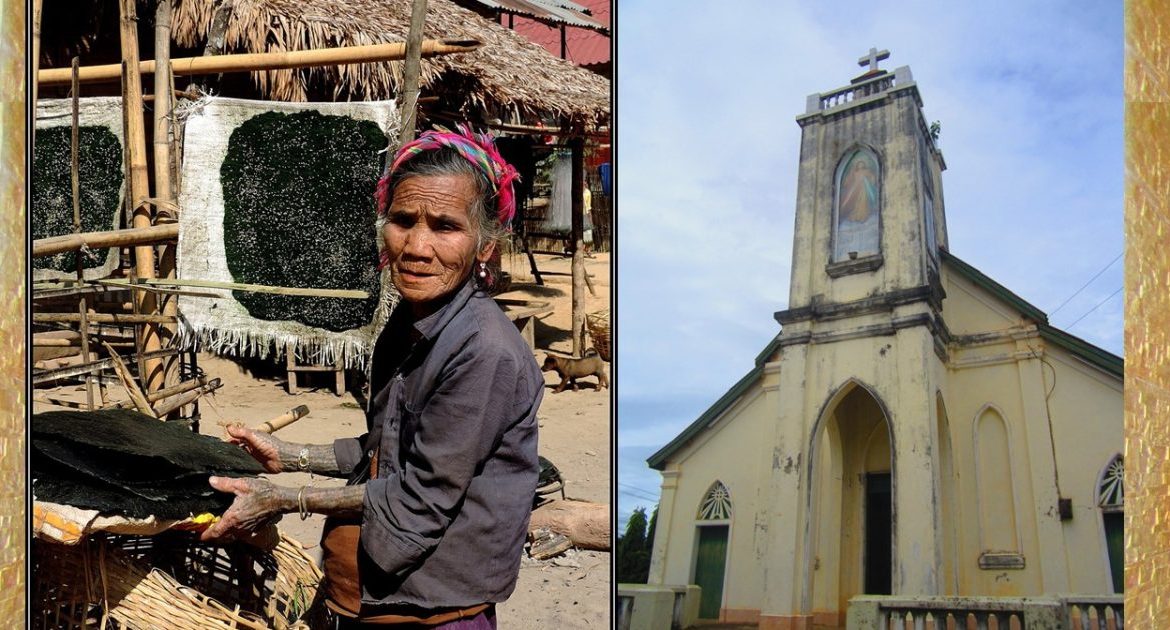


The communist government of the Lao People’s Democratic Republic continues its decades-long repression of ethnic minorities and Christians. Chinese investment has further exacerbated the problem, with the Lao government displacing indigenous communities to make room for Chinese-funded projects. Analysts have noted that each time the PRC enters a new phase of religious and ethnic repression, Laos follows suit, restricting ethnic and religious freedom that the ruling party perceives as a threat to national unity and party control.
Laos is the most ethnically diverse country in mainland Southeast Asia, with a population of about 7 million spread across dozens of ethnic groups. The government officially recognizes 49 ethnic groups and 160 subgroups, categorized into three geographic tiers: Lao Loum in the lowlands, Lao Theung in midland regions, and Lao Sung in the highlands.
Ethnic Lao make up just over half the population, are concentrated in lowland areas, and practice Theravada Buddhism. Lao Theung groups, roughly a quarter of the population, live in midland regions and follow animist traditions. Lao Sung groups, including the Hmong and Yao, inhabit mountainous regions and belong mainly to Hmong-Mien and Sino-Tibetan language families.
Although the constitution guarantees equal status for all ethnic groups and protects religious freedom, the gap between formal legal rights and actual practice is well-documented. Political life is dominated by the Lao People’s Revolutionary Party and its ethnic Lao elite. The government does not recognize the concept of indigenous peoples, despite having voted in favor of the UN Declaration on the Rights of Indigenous Peoples.
Ethnic minority communities in Laos face significant and measurable disadvantages relative to the dominant Lao-Tai population across every economic indicator. According to IWGIA’s Indigenous World reports, which draw on Lao government social indicator survey data, indigenous peoples relying on unimproved or surface water range from 20% to 32.5% of the population, compared to just 8.5% among Lao-Tai.
Lack of sanitation and access to toilets is another issue. While 13.9% of Lao-Tai practice open defecation, that figure rises to between 30.3 and 46.3% among indigenous communities. These disparities are corroborated by UNICEF data showing that 32.6% of the rural population overall practices open defecation compared to 4.25% in urban areas, with the burden falling disproportionately on poor ethnic minority groups in rural areas.
The education gap is similarly documented. Analysis of LSIS-II data indicated that 20%–30% of children in rural, poorer, or non-Lao-Tai ethnic households do not attend Early Childhood Education (ECE).
IWGIA has reported that children from indigenous groups have lower school-attendance rates than Lao-Tai children, with the Mon-Khmer ethnic group recording the lowest attendance and highest dropout rates in the country, alongside the lowest overall socioeconomic status.
A 2025 peer-reviewed study published in Cogent Education found that out-of-school children in Laos are disproportionately drawn from poor communities, ethnic minorities, and girls. The share of out-of-school children reaches approximately 30% in Phongsaly Province in the north and 28.4% in Savannakhet Province in the south, compared to 13.4% in Vientiane Capital.
Language is a compounding factor. Ethnic minority children are required to switch to the official Lao language upon entering school, creating an immediate barrier to comprehension and continuity.
Underlying the disparities between ethnic minorities and the Lao-Tai majority is a Chinese-driven development model, with investment from the PRC increasingly disadvantaging indigenous communities. Land and natural resources belonging to ethnic minorities are under growing pressure from government investment-promotion policies and commercial resource extraction, including large-scale hydropower development and logging concessions.
Chinese state-owned companies have invested $3.2 billion in Laos’s energy sector over five years, constructing hydroelectric dams that have forced ethnic minorities, including the indigenous Khmou people along the Mekong, off ancestral lands, often with broken or delayed compensation promises.
The Laos-China Railway, financed by China’s Export-Import Bank and completed in 2021, permanently displaced more than 4,400 families along its route through the country’s most ethnically diverse northern regions. The railway has also accelerated a boom in Chinese-owned agricultural plantations, with satellite data confirming that Chinese banana and durian operations have cleared protected forests in ethnic minority provinces, including Attapeu and Luang Prabang.
Laos has ratified several major international human rights instruments, including the International Convention on the Elimination of All Forms of Racial Discrimination (1974), the Convention on the Elimination of All Forms of Discrimination Against Women (1981), the Convention on the Rights of the Child (1991), and the International Covenant on Civil and Political Rights (2009).
In practice, however, the government severely restricts freedom of speech, association, assembly, and religion, and civil society operates under close state control. Organizations that openly focus on indigenous peoples’ rights, or that use indigenous peoples’ terminology in the Lao language, are not permitted to operate. According to IWGIA, open discussion of indigenous peoples’ issues with government officials remains sensitive, as the government views such framing as implying claims to special rights outside the official multiethnic national framework.
Christian identity and ethnic minority identity in Laos are deeply intertwined. Practitioners of Protestant Christianity are drawn predominantly from the ethnic minorities, particularly the Khmou and Brou in the north and the Hmong and Yao in the highlands. Protestantism has expanded rapidly in these communities, meaning that when the government targets Christians, it is also targeting highland and midland ethnic minorities while leaving lowland ethnic Lao Buddhists largely undisturbed.
The World Evangelical Alliance has reported that Protestant Christianity, and the Hmong community in particular, is viewed by Lao authorities as an American or imperialist import and a threat to Communist rule. This political framing, Christianity as foreign subversion, compounds the ethnic suspicion already directed at the Hmong because of their alliance with the United States during the Vietnam War.
After the Communist takeover in 1975, the regime’s official newspaper announced that the Hmong would be “exterminated to the last root.” Since the late 1970s, military offensives have targeted Hmong communities in Phou Bia and Xaisomboun, where residents have faced attacks, arbitrary arrests, enforced disappearances, extrajudicial killings, and military blockades. Reports indicate the use of heavy artillery, chemical weapons, and starvation tactics.
Hmong who surrendered to authorities have been placed in camps rather than allowed to return to their villages, and access by independent humanitarian monitors is routinely denied.
Though many Hmong were traditionally animists, large numbers converted to Christianity in the 20th century, adding a religious dimension to their persecution. The Hmong Christian community, concentrated in central and southern Laos, faces pressure to conform to Buddhist or animist rituals. Village mediation units push Christians to compromise their beliefs, and Christian burials have been obstructed in public cemeteries.
At the 60th session of the UN Human Rights Council, the Unrepresented Nations and Peoples Organization highlighted ongoing violations against the Hmong, including military operations, enforced disappearances, forced relocations, and extrajudicial killings. The Lao government declined to accept UN recommendations to grant humanitarian access to Xaisomboun Province or recognize the rights of Hmong communities such as the ChaoFa, whose existence it denies.
Laos’ growing dependence on China has intensified restrictions on Christianity. As China enforces strict controls over religion within its borders, Laos has followed suit. A 2024 Open Doors report found that ideological control and foreign influence are weakening religious freedoms across the country.
Decree 315, passed in 2016, codifies this control by requiring state approval to print religious literature, build religious facilities, and travel abroad for religious meetings. All religious organizations must register with the government. In practice, enforcement falls far more heavily on Christians than on Buddhists.
Despite a constitutional guarantee of religious freedom, authorities heavily monitor Christian religious activities. Churches are required to report all gatherings to the administration, driving many believers into unregistered house churches. About 75 percent of government-approved Lao Evangelical Church congregations lack permanent structures and hold services in homes. Many Christians who have been expelled from their homes have taken refuge in forests without access to food, shelter, or medical care.
Open Doors International documented, in its 2024 reporting period, at least four Christians killed, 159 expelled from their communities, 60 arrested, and 25 churches attacked. Christians also face economic retaliation and are routinely denied education and government employment. In January 2024, six Christian families in one village were summoned and ordered to stop practicing their religion or have their meeting place demolished.
In February 2024, Radio Free Asia reported that village authorities destroyed a house used for Sunday worship. In 2020, a pastor arrested for refusing to renounce his faith was convicted of causing social disorder and breaking village unity, sentenced to one year in prison, and fined $200. That same year, authorities in Salavan Province expelled seven Christians from their homes.
Persecution of Christians in rural areas is more severe than in cities, where the government maintains a degree of tolerance in provincial capitals. Certain provinces are particularly dangerous for Christians, especially in the north where the Hmong are concentrated. Pastors in northern Laos have also raised concern over the trafficking of young women from ethnic minority groups, including Hmong Christians, across the border into China, where they are coerced into forced marriages or sex work.
The UN Special Rapporteur for cultural rights, following a 2024 visit, raised concerns about policies assimilating ethnic minorities into the dominant Lao ethnic group, prejudice against non-dominant cultural practices labeled as “backward,” and village relocations carried out without free, prior, and informed consent. Indigenous peoples lag behind the ethnic Lao-Tai majority at all economic levels, and their land is under increasing pressure from government development policies and foreign investment, notably from Chinese state-owned firms operating in autonomous Special Economic Zones. Authorities generally do not investigate or prosecute abuses committed within these zones.
Genocide Watch classifies Laos at Stage 8: Persecution, noting that ethnic and religious minorities are branded as enemies of the state, government propaganda fuels societal divisions, and the state carries out forced displacement, arbitrary arrests, enforced disappearances, and military attacks targeting minority communities.
The post Communist Laos: Repression of Christians and Minorities Continues appeared first on The Gateway Pundit.