
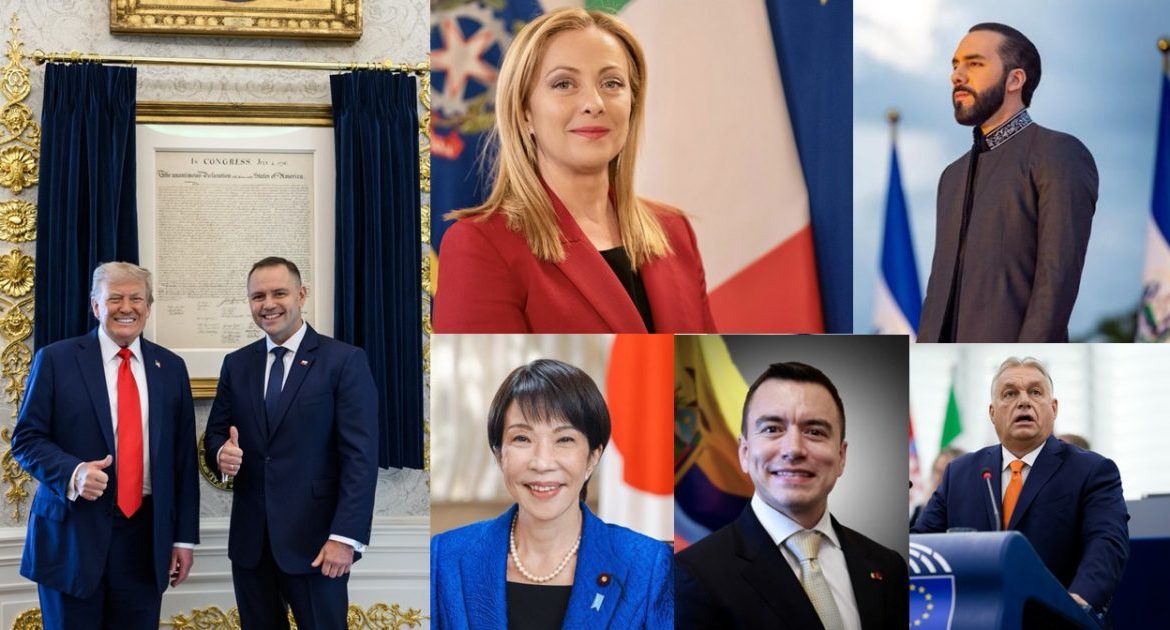
Right-Leaning Candidates on the Rise, Leading Elections Around the Globe


Just a few years ago, during the Biden era, it seemed the whole world had shifted left, with only a few outposts, such as Hungary and Poland, standing against the tide of woke ideology and the drift toward socialism. Today, that trend is reversing.
A right-wing movement is building across Latin America and Europe and, to a lesser extent, Asia and Africa, with many countries now led by conservative governments and several others likely to shift in the next election cycle.
In Latin America, conservative or right-leaning leaders already govern multiple countries.
In Argentina, Javier Milei won the presidency in November 2023 on a libertarian, anarcho-capitalist platform and followed with a strong midterm performance in October 2025, securing more than 40 percent of the national vote.
In Ecuador, incumbent Daniel Noboa won re-election in April 2025, defeating a left-wing challenger in a campaign focused on crime and corruption.
El Salvador’s Nayib Bukele, re-elected in 2024, is one of the region’s most prominent conservative leaders, known for his hardline anti-gang policies that have transformed El Salvador from one of the most dangerous nations in the Americas to one of the safest.
Paraguay’s Santiago Peña governs in alignment with Milei’s emerging regional bloc, while Panama’s José Raúl Mulino won the presidency in 2024, defeating a center-left incumbent. In the Dominican Republic, Luis Abinader serves as a center-right president.
Bolivia also shifted right, with Senator Rodrigo Paz Pereira winning the October 2025 presidential runoff, ending decades of dominance by the leftist Movimiento al Socialismo party.
In Chile, voters elected José Antonio Kast to the presidency for the 2026–2030 term, delivering the largest vote total in the country’s history.
Honduras elected conservative candidate Nasry Asfura in November 2025 with 40.3 percent of the vote, and Costa Rica followed in early 2026, electing Laura Fernández Delgado by a wide margin while her Sovereign People’s Party secured a legislative majority.
Peru remains an outlier in terms of political stability rather than ideology. José Jerí, a member of the right-wing Somos Peru party, became interim president in October 2025 following the impeachment of Dina Boluarte, but was himself impeached in February 2026, underscoring the country’s political turmoil.
Venezuela may also be shifting. On January 3, 2026, U.S. special forces captured Nicolás Maduro and flew him to New York to face narcoterrorism charges, ending his rule after more than a decade.
His vice president, Delcy Rodríguez, assumed the interim presidency, but the regime’s core institutions, including the military, Supreme Court, and ruling Socialist Party, remained intact.
Opposition candidate Edmundo González Urrutia is widely believed to have won the contested 2024 election by a large margin.
Secretary of State Marco Rubio has called for free and fair elections, with U.S. officials suggesting they could take place by 2027. Whether Venezuela transitions to democracy or stabilizes under a reconfigured authoritarian system remains uncertain.
Looking ahead, several elections could strengthen the region’s conservative shift.
In Colombia, President Gustavo Petro’s term ends in 2026, and given his unpopularity and the country’s historical tendency toward right-leaning governments, analysts expect a difficult path for his coalition to retain power.
Brazil will hold elections in October 2026, with multiple conservative candidates in the race.
While Lula leads in polling, figures such as Flávio Bolsonaro and São Paulo Governor Tarcísio de Freitas remain competitive, even as Jair Bolsonaro is barred from running following his conviction related to an alleged January 2023 coup attempt.
Peru is also expected to hold a presidential election in 2026, with right-wing Congresswoman Keiko Fujimori among the leading contenders. If trends continue, these elections could expand conservative influence across the region, potentially leaving Mexico as the only major leftist holdout.
In Europe, the pattern is similar. In Germany, Friedrich Merz of the Christian Democratic Union/Christian Social Union won the February 2025 snap election after the collapse of Olaf Scholz’s coalition government in late 2024.
Merz’s conservatives secured 208 seats in the 630-seat Bundestag, while the AfD placed second with 152 seats, its best result ever, doubling its support from 10.3 percent in 2021.
AfD leader Alice Weidel, the party’s chancellor candidate, has become the face of Germany’s fastest-growing political force.
She told supporters the result put the party on a path to government, if not now, then at the next election in four years.
An economist by background, she blames globalization for Germany’s problems, calls for tighter immigration restrictions, and supports a return to fossil fuels, citing Margaret Thatcher as her political model.
She received support from Elon Musk and was the first AfD politician invited to a pre-election TV debate, where she sparred with Chancellor Scholz and CDU leader Merz.
Hungarian Prime Minister Viktor Orbán described her as the future of Germany, and Vice President JD Vance met with her during his February 2025 Munich trip.
In May 2025, Germany’s Federal Office for the Protection of the Constitution classified the AfD as a confirmed right-wing extremist organization, though a 2026 court injunction suspended that designation.
All mainstream parties maintain a firewall against coalition with the AfD, leaving Weidel with influence but no executive power for now. She is part of a growing group of women leading Europe’s right, alongside Italy’s Giorgia Meloni and France’s Marine Le Pen.
Austria’s far-right Freedom Party finished first in the September 2024 elections.
After coalition talks collapsed and Chancellor Nehammer resigned, President Van der Bellen tasked Freedom Party leader Herbert Kickl with forming a government.
Giorgia Meloni has consolidated her position in Italy since taking power in 2022.
Her Brothers of Italy party won over 28 percent of Italy’s EU vote, and she remains one of the few European leaders enjoying strong popular support. In Poland, conservative nationalist Karol Nawrocki narrowly won the presidency in 2025.
Hungary’s Viktor Orbán remains entrenched in power, with his Fidesz party heading the Patriots for Europe group in the European Parliament, which holds 84 seats.
In the Netherlands, right-wing parties won the most votes in 2023, and Geert Wilders’s Party for Freedom remains a major force, with his coalition forming the Dutch government.
Marine Le Pen’s National Rally in France won 31.4 percent of the vote in EU elections, prompting President Macron to dissolve parliament and call snap elections.
Only a coalition of the left and centrists blocked the RN’s path to power in the second round.
In the United Kingdom, while Labour holds power, Reform UK has made significant gains, winning roughly 42 percent of seats in local elections and taking eight authorities from Conservative strongholds.
Prime Minister Starmer recently described Reform as his main competitor for No. 10 Downing Street.
Across the 2024 EU Parliament elections, populist or far-right parties came in first in France, Italy, Austria, Hungary, and Slovakia, and placed second in Germany, Poland, and the Netherlands.
Right-wing populists are now in government or supporting ruling coalitions in Belgium, Croatia, Finland, Hungary, the Netherlands, Slovakia, and Sweden.
In Asia, the most significant recent development is Japan. Sanae Takaichi took office as Japan’s first female prime minister in October 2025, called a snap election, and won a landslide in February 2026, securing the strongest majority for a Japanese government since World War II.
The LDP now has enough seats to override the upper house, propose constitutional amendments, and chair all lower house committees.
Takaichi has pledged to revise security and defense policies to bolster Japan’s offensive military capabilities, lift a ban on weapons exports, and push tighter immigration measures.
In India, Narendra Modi and his Bharatiya Janata Party won a third consecutive victory in 2024 but were forced into a coalition after losing their outright majority.
In Indonesia, Prabowo Subianto won the February 2024 presidential election with 58 percent of the vote in the first round. He leads Gerindra, a nationalist, right-wing populist party, and assumed the presidency in October 2024.
Benjamin Netanyahu pieced together the most right-wing and religious government in Israel’s history following his 2022 victory.
He has dominated Israeli politics for three decades, serving as prime minister for eighteen of the last twenty-nine years. Elections are expected by October 2026, with the opposition remaining split, creating a structural opportunity for Netanyahu to remain in power.
The consistent pattern across these cases is economic discontent, opposition to illegal immigration, anti-crime sentiment, and voter dissatisfaction with incumbent centrist or left-leaning governments.
The post Right-Leaning Candidates on the Rise, Leading Elections Around the Globe appeared first on The Gateway Pundit.