
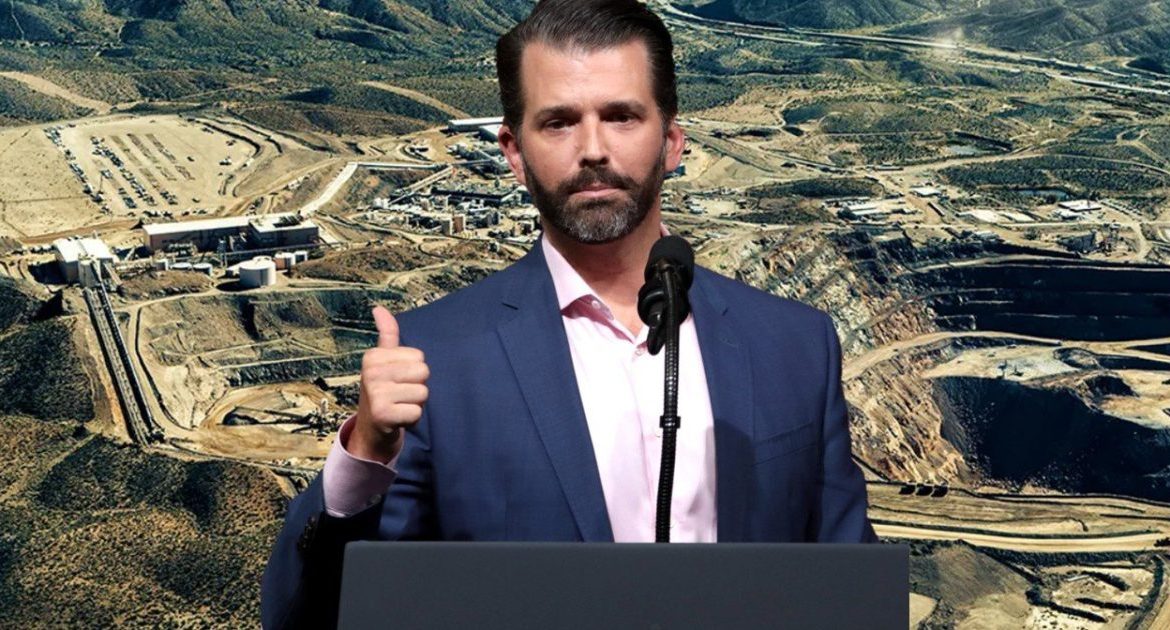
The Don Jr. Controversy: Rare Earth Funding Is Bipartisan National Security Policy, Not Corruption


A claim circulating in among Democrats and mainstream media holds that Donald Trump Jr. owns a rare earth company that received a $620 million government loan, representing corruption by the Trump administration.
The claim is false on multiple levels.
Vulcan Elements, a rare earth magnets startup, received the loan from the Pentagon’s Office of Strategic Capital in November 2025. Trump Jr. neither owns nor operates Vulcan Elements. He is a partner at 1789 Capital, a venture capital firm that made a minority equity investment in Vulcan Elements in August 2025, approximately three months before the loan was announced.
That investment was part of Vulcan’s Series A funding round, which raised $65 million and was led by Altimeter Capital, a firm unrelated to Trump Jr. Based on public records, Trump Jr. holds no direct equity stake in Vulcan, serves on no board or advisory role, and had no involvement in the loan process. The Pentagon confirmed that Trump Jr. and 1789 Capital were “not involved in any aspect” of the negotiation. Vulcan’s CEO stated he had “zero contact with the president’s son” and that 1789’s stake carries no board or observer rights.
The Office of Strategic Capital was established in December 2022 under the Biden administration as part of a broader federal initiative to expand domestic rare earth production and reduce dependence on China. Vulcan Elements was one of several companies to receive funding under that program. ReElement Technologies received an $80 million OSC loan under the same initiative.
Government support for domestic rare earths predates the current administration. President Trump issued an executive order in 2020 declaring U.S. reliance on foreign adversaries a national emergency. President Biden followed with his own February 2021 executive order on supply chains, and under his administration companies announced more than $120 billion in investments in battery and critical mineral supply chains.
The Departments of Energy, Defense, Treasury, and Commerce all participated through grants, loans, and tax credits. Since 2020, the DOD alone has committed over $439 million toward domestic rare earth supply chains, with a stated goal of developing a complete mine-to-magnet supply chain by 2027. Trump’s “One Big Beautiful Bill Act,” signed July 4, 2025, allocated $500 million in credit subsidy funding enabling up to $100 billion in loans for critical minerals production, the authority under which the larger Trump-era deals were structured.
The DoD purchased $400 million in preferred stock in MP Materials, becoming the company’s largest shareholder, issued a $150 million loan for heavy rare earth separation, and guaranteed a price floor of $110 per kilogram on neodymium-praseodymium for ten years with a commitment to purchase 100 percent of magnets produced at the new facility for a decade. The Department of Commerce signed a deal with USA Rare Earth promising a $1.3 billion loan alongside $277 million in proposed federal funding, its sixth federal investment in mining and minerals processing.
Lynas USA received a $258 million contract for construction of a heavy rare earths refinery. Ucore Rare Metals received $18.4 million from the U.S. Army Contracting Command for a commercial-scale separation facility in Louisiana. The DOE took a 5 percent warrant-based equity stake in Lithium Americas as part of a renegotiation of a $2.2 billion loan for the Thacker Pass project.
EXIM approved an $11 million loan for IperionX in Virginia and a $16 million direct loan to Empire State Mines in New York. Syrah Resources’ graphite-anode plant in Louisiana was financed in part by a $102 million DOE loan.
The strategic rationale for this level of support is straightforward. The U.S. is almost entirely dependent on China, which supplied 70 percent of rare earth imports in 2023. China has suppressed prices to drive Western competitors out of the market, meaning private capital alone cannot sustain a domestic industry against Chinese state-backed competition.
The NdPr price guarantee of $110 per kilogram is more than twice MP Materials’ realized market price of $51 per kilogram in 2024, which illustrates the scale of the distortion. The government’s response has been to mimic China’s model of strategic capitalism, a position that has drawn bipartisan support across multiple administrations.
Virtually every operating or developing U.S. rare earths company has received federal loans, grants, equity investments, price guarantees, or offtake contracts. Therefore, there is nothing unique or suspicious about the Vulcan loan when all of the facts are considered.
The post The Don Jr. Controversy: Rare Earth Funding Is Bipartisan National Security Policy, Not Corruption appeared first on The Gateway Pundit.