
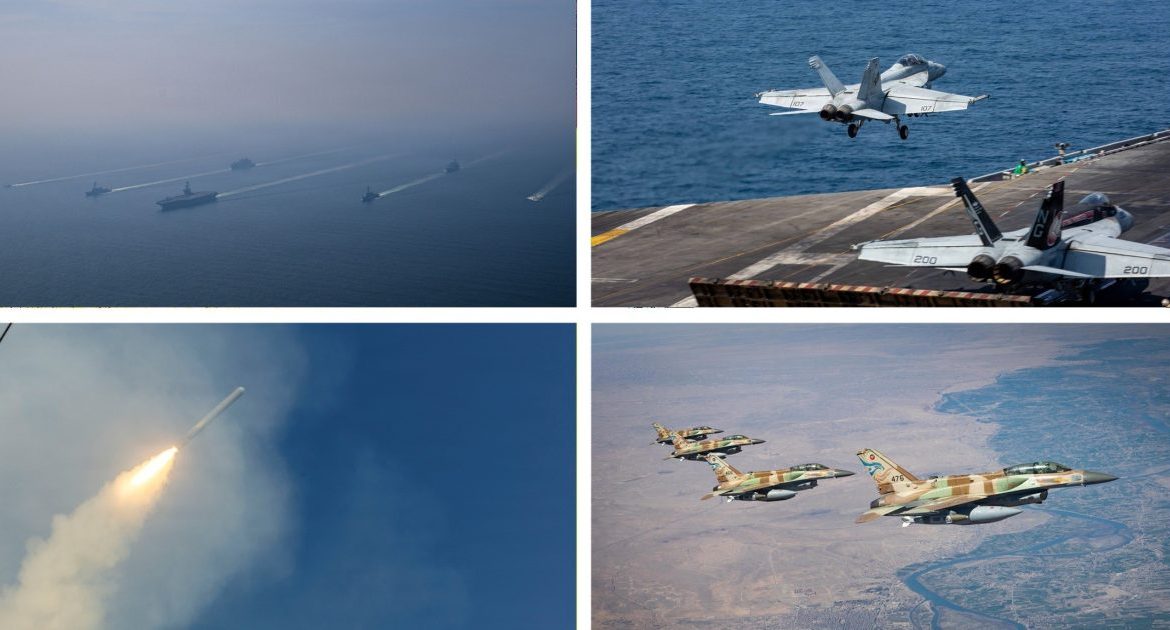
Congress Has Yet to Declare War on Iran, but This Campaign is Consistent with Historical Precedent

The U.S. is now two weeks into a military strike campaign against the government of Iran, prompting observers to question whether Congress will officially declare war on the Islamic Republic.
The Gateway Pundit spoke to Dr. Chase Spears, a retired U.S. Army combat veteran, public affairs officer, writer, and host of the Finding Your Spine podcast. In a recent article for RedState, he described himself as an “almost-isolationist,” indicating that he largely supports a policy of remaining apart from the affairs or interests of other countries.
Why? Because Dr. Spears is a product of the Global War on Terrorism (GWOT), having been deployed to combat zones twice throughout his career, and serving with soldiers who spent years of their lives in hostile zones overseas. “We saw how Iraq turned out; we saw how Afghanistan turned out,” he explained.
He went on to reveal two reasons why his primary default is one that’s against wars. First, he said, “the [U.S.] nation has not shown a willingness to commit to what’s needed to get the job done in the entirety of my lifetime.”
He contended, “When you go to war as a nation, you should go as a last resort, willing to exert the amount of force and violence necessary in order to get the job done as quickly as possible to quickly restore a just peace.”
Second, Spears said, he’s “traditionally against new military campaigns because there is a lot of reason to question the constitutionality of how we’ve done war since the end of World War II.” The U.S. Constitution divides war powers between Congress and the President. According to Article I, Section 8, Congress holds the exclusive power to “declare War.”
However, he pointed out that “when you look at the course of American history, only a very small number of the wars that we’ve been engaged in were ever congressionally declared.”
For example, the United States never formally declared war for the Civil War, Vietnam, or Afghanistan. In recent history, the United States formally declared war during World War II, starting with a declaration against Japan on December 8, 1941, one day after the attack on Pearl Harbor.
Many have declared President Donald Trump and War Secretary Pete Hegseth’s actions against Iran as unconstitutional. In response, Spears asked, “Where have they been the entirety of our lifetimes? Where were they on Vietnam, Desert Storm, Afghanistan, Operation Enduring Freedom, on Operation Iraqi Freedom? Where are they on our proxy war with Russia through Ukraine?”
“I’m not saying it’s the right thing to do, that we have walked away from how the Constitution says we declare war, but if we’re going to throw the flag on this action is Iran and we have nothing to say about all the other wars, then there’s a selective use of that flag and there’s hypocrisy in that,” declared Spears.
The U.S. Army veteran said he has “come to accept, lamentingly, that presidents do not necessarily follow the constitutional provision for consulting Congress.”
In his opinion, Congress has largely abrogated its responsibility, being more willing to “complain, whine, and moan, while avoiding the responsibility of making the decision to go to commit troops to combat.”
“If Congress wants to do something about it,” Spears said, “its elected members control the purse. That’s why the framers of the Constitution split control of the military between Congress and the President, [explaining] Congress is also the funding agent [according to Article I, Section 8], and the president is established as Commander in Chief [in Article II, Section 2].”
Despite the widespread criticism directed at Trump and Hegseth for their actions regarding Iran, Spears is in favor of the campaign. He explained, “Iran has been the world’s leading exporter of terrorism for 47 years, [and] they have murdered my comrades in arms.”
“They have killed indiscriminately for decades, while funding, enabling, equipping, training, and encouraging all these other terrorists around the world to do the same,” added Spears. “The can has been kicked down the road for too long, [and] it’s time to cut the head of the snake.”
The father of five is also concerned about his children. “Do I want my kids and my grandkids to have to adopt the fatalistic view of this age that nothing virtuous can be done with state power?” The answer is no. “If we have an opportunity to actually make a meaningful difference in global security by crushing the Iranian regime, I think we need to do it.”
In conclusion, Spears also noted that “this military campaign is a noble cause, a reality heightened by the fact that the Iranian people want it.”
Retired Air Force Colonel Rob Maness, a former bomber squadron commander who served the U.S. military for more than 30 years, agreed with Spears, pointing out that “Iran is the world’s leading exporter of terrorism.”
What’s more, Maness contended, “Iran declared war on us in 1979, so I view this quite differently than a lot of MAGA types and fully support [this campaign] as long as we don’t do a stupid occupation and/or invasion.”
Numerous historians and analysts agree, viewing the takeover of the U.S. Embassy in Tehran on November 4, 1979, along with the capture of 52 American hostages, as an act of war or the onset of a prolonged, undeclared conflict.
Additionally, the 2001 Authorization for Use of Military Force (AUMF) is a congressional joint resolution enacted shortly after the September 11 attacks, authorizing the President to employ all “necessary and appropriate force” against nations, organizations, or persons involved in the attacks.
“[Iran] harbored 9/11 associated terrorists so the AUMF post 9/11 still applies,” Maness also argued. “So, when a nation goes to war with us and the POTUS/CINC decides to end it,” he simply said, “we have to be ruthless.”
The post Congress Has Yet to Declare War on Iran, but This Campaign is Consistent with Historical Precedent appeared first on The Gateway Pundit.