
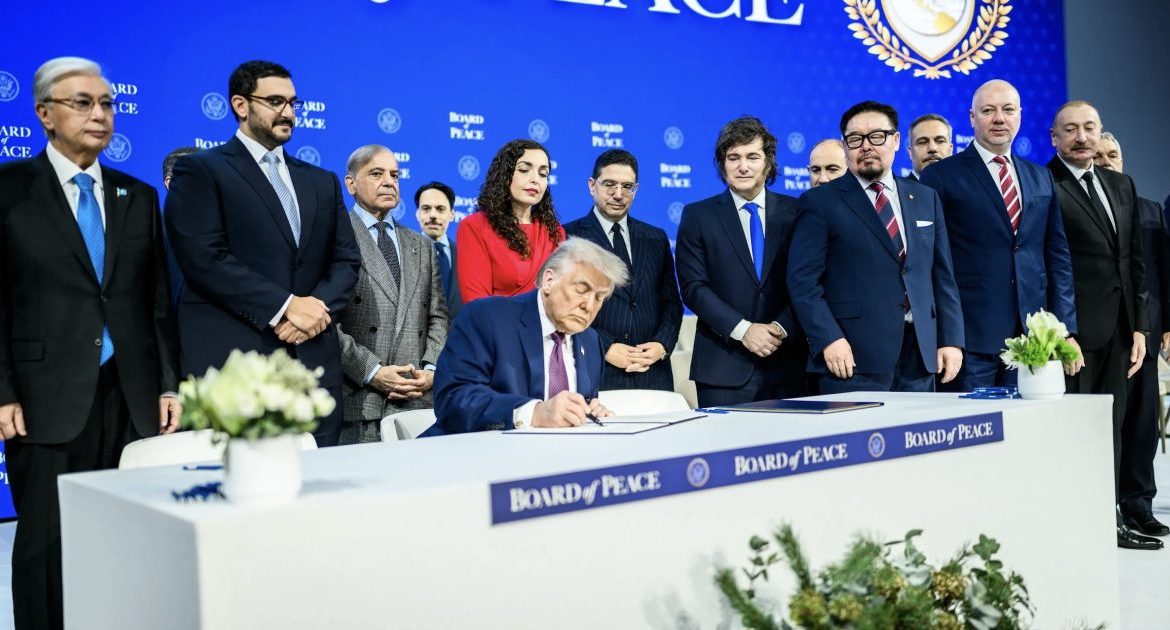
Trump’s ‘Board of Peace’ Is Doing the Job That NATO and the UN Can’t


For nearly a century, the North Atlantic Treaty Organization and United Nations were instituted as part of a post-World War II global arrangement, led by the United States, to maintain peace.
This peace was envisioned by its designers to last for posterity – a peace supported by multilateralism and backed by (so-called) “international law.”
This was the infamous “rules-based world order,” which was said to have surpassed or overcome the history of mankind, and the conflicts that are inevitable when dealing with humans due to our fallen nature.
The delusion stated that not only had history been transformed into a one-world order, with peace secured indefinitely, but that human nature had somehow also been changed with it.
The sinister implication was that every man’s soul was not tainted by original sin after all, a fundamentally atheistic world view that denies a core lesson of Genesis
Alas, the many decades since World War II showcased more than enough evidence that the rules-based order, and its supporting institutions like NATO and the UN, were always a folly.
Though war was declared over, still the wars came: Korea, Vietnam, Iraq, Afghanistan, Ukraine, Gaza. With each war, it became harder and harder to believe that history had ended.
Faith in the institutions that perpetuated this belief – most significantly, NATO and the UN – absolutely dissipated. Donald Trump’s presidencies marked the final nail in the coffin to this fantasy.
The President exposed the emperor without clothes. In its place, the President offered a new institution, one uncorrupted from the ridiculous assumptions that undergirded its predecessor institutions.
The Institute of Peace is not like the other two institutions because it does not believe war can be abolished.
It reckons with human nature realistically, not fantastically, knowing that while peace should always be the goal, it is impossible to eradicate conflict outright. Not only is it impossible, it is undesirable in some cases.
Global relations and indeed, even domestic relations – in politics, business, and through the course of everyday human interactions – are undergirded by subterranean power dynamics that are simply never going away.
The stronger powers typically have more leverage in a negotiation, and therefore, more often than not, win.
The David versus Goliath scenario, the notable exception, provides only further support for the rule. And that is a rule that is not going away anytime soon.
Rather than run away from the truth, the President and his administration have accepted it in a sober and statesmanlike manner. Knowing that global relations will not automatically be peaceful without a backing arbiter or executive to guarantee such stability is in some ways freeing.
It puts one at an advantage over those, like previous recent administrations, who profess in the whimsical dogmas of the globalist creed.
Sobriety and realism, however harsh the truths they might uncover, are always preferable to groundless hope. The idea that war was eradicated once and for all following the defeat of Nazi Germany begs a deeper question of why?
What exactly changed over the intervening eighty years? Did human nature really change? Or did its political elites, high off the laurels of victory, begin mistakenly internalizing a temporary condition – however protracted the post-war order was – and begin thinking that that condition would apply to all peoples for all time from here on out?
In any event, to the extent that anyone still believed in the latter foolishness, President Trump, Marco Rubio, and others in his administration have gently walked the global dogmatists back from the edge of the cliff.
The President’s remarks in this year’s Davos conference were the ultimate signal of America shaking its European counterparts brutally awake of their illusion.
Marco Rubio’s follow-up remarks a month later, in Munich, further underscored that point: the post-war order was observed as a relic of the twentieth century. The twenty-first century presents newfound challenges. Time to get a grip.
With the rapid rise of adversaries like China and Russia (which ironically would not have been possible, or at least severely complicated, without the disastrous hubris of the elite class that subscribed to the end of history arguments – and through those arguments, created policy out of them like admitting China to the World Trade Organization), America must adapt to an evolving world order, one based on realpolitik not globalism, if it is to maintain its competitive edge.
And given how competitive the modern world is, it may not be enough that America remains “simply another competitor.” Thus, the sooner it accepts the changed world situation, the better.
It is plausible that the world has been this way for quite some time now, but global elites are only just starting to wake up.
Richard Nixon’s détente with the Soviets and Chinese in the early 1970s should have, nearly a half century ago, portended what was to follow in the coming decades of geopolitical relations to the ruling classes of the West.
However, the history of the last thirty years, with failed escapade after failed escapade in the Middle East, and then, more recently, in Eastern Europe, should have really opened everyone’s eyes.
It is shocking that nobody really began noticing the situation until Donald Trump burst onto the political scene a decade ago and began seriously probing the efficacy of these institutions.
It is even more of a shock that it took another full decade before meaningful policy was implemented to begin reversing the damage.
But here we are. And luckily now some progress is finally being made. Concurrent with the peace deals in Gaza and the Ukraine must be a guarantee for a stronger arbiter in global relations.
The President has enunciated what intuitive onlookers have known for a while now: real peace is not possible without a strong America willing to lay down the terms of the agreement.
Without a robust United States orchestrating everything, the rest of the world has little to back up their words. As the President pithily puts it: “the world will start killing itself.”
The Greenland test run was a perfect example of NATO’s utter impotence: the United States, if it so wanted, could have well taken the “piece of ice,” as the President humorously put it.
The symbolic chest-beats to military action, made by some of NATO’s members, were only that: symbolic. In a negotiation, such acts go nowhere if they cannot be supported by real strength. And so, the performance falters.
Ukraine is another great example: “an attack on one is an attack on all” falls flat when the “all” lack the military, financial, and political means to challenge the aggressor. Hence, the Ukraine war of the last half-decade.
That is not something to despair in, but to recognize as a fact of life. Beyond that, it is a fact of human nature. War is inevitable. Understanding those facts, and taking on the truth head-on, is the quickest way to peaceful resolution.
That is at the core of the President’s new “Institute of Peace,” an organization that dispenses with every false assumption that made NATO and the UN a complete and total failure.
Recognizing these failures goes a long way towards discovering the truth. And with that truth, the chance for an abiding peace, which can only be possible through recognition of the power dynamics that govern men in the real world, not a made-up one.
The post Trump’s ‘Board of Peace’ Is Doing the Job That NATO and the UN Can’t appeared first on The Gateway Pundit.