
GREGORY LYAKHOV: My Generation’s Anti-ICE Activism Is Outpacing Civic Knowledge


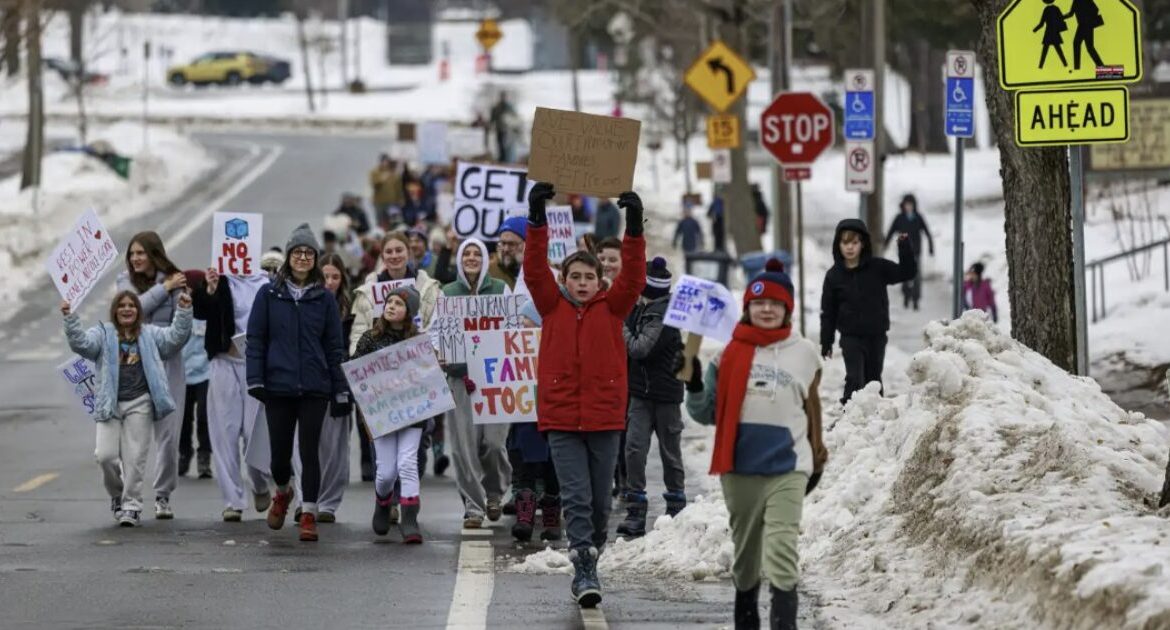
When students walked out of high schools across the country to protest ICE, the demonstrations were quickly framed as proof of political awareness and civic engagement. In one sense, that framing is understandable. Civic participation matters, and a generation willing to engage with public issues should not be dismissed.
The concern is not protest itself, but the apparent lack of understanding among many participants about what they were protesting and how change within the federal government actually occurs.
Across school districts nationwide, students demanded the abolition of ICE or called on the president to “end” ICE entirely. Those demands were often delivered with confidence and moral certainty, yet they reflected a fundamental misunderstanding of the structure of government.
ICE does not write immigration law, does not determine national policy, and does not operate independently of statutes passed by Congress. ICE is an enforcement agency, legally obligated to carry out federal law as written.
Protesting ICE, therefore, does not change the underlying policy students claim to oppose. If the objective is legislative reform, Congress is the institution that holds that authority.
The distinction between legislative and executive power should be familiar to any student who has received a serious civics education.
The fact that it is not widely understood points to a deeper problem within K–12 education. Students are encouraged to express political opinions and participate in demonstrations, but they are rarely taught how power is structured or where accountability actually lies.
Civic engagement is promoted in theory, while civic literacy is treated as optional.
Large-scale walkouts are often presented as evidence of a politically active generation. In practice, they tend to function as symbolic actions that substitute for sustained civic involvement. If young Americans were engaging with the political system at the level these protests suggest, voter turnout among young voters would reflect that reality. It does not.
Participation in elections remains consistently low, indicating a disconnect between visible protest and meaningful engagement with democratic institutions.
Civic education has increasingly avoided institutional clarity. Teachers are often discouraged from addressing political structure in depth, and administrators frequently treat controversy as something to be managed rather than examined.
As a result, classrooms emphasize broad themes such as “activism” and “engagement” without grounding those ideas in constitutional authority, legislative responsibility, or enforcement mechanisms.
The consequences of this approach extend beyond ICE. Students are increasingly encouraged to adopt strong political positions without being required to understand policy tradeoffs, historical outcomes, or institutional constraints. Complex systems are reduced to slogans, and moral certainty replaces analysis.
Civic participation becomes performative rather than informed.
This is not a reflection of students’ intelligence. Rather, it reflects what schools have chosen to prioritize. Classrooms often avoid disagreement, not because students lack opinions, but because debate is treated as disruptive or risky.
Over time, students learn how to express approved views without being challenged to defend them or understand opposing perspectives.
The ICE walkouts illustrate the cost of that imbalance. When students protest without understanding the institutions they are targeting, civic action loses its effectiveness. Democracy does not benefit from engagement that is disconnected from knowledge.
Civic education should not discourage protest. It should prepare students to protest intelligently. That requires teaching how Congress operates, what federal agencies do, and where authority actually resides. Students must be taught to debate, question, and analyze power rather than merely react to it.
If schools continue to promote civic participation without civic literacy, protests will grow more visible while understanding continues to erode.
The post GREGORY LYAKHOV: My Generation’s Anti-ICE Activism Is Outpacing Civic Knowledge appeared first on The Gateway Pundit.