
False Dawn by Cato’s George Selgin Ranked Among “10 Best Books of 2025” by The Wall Street Journal
False Dawn: The New Deal and the Promise of Recovery, 1933–1947, by former Cato Senior Fellow George Selgin, was ranked among the “10 Best Books of 2025” by The Wall Street Journal this week. Selgin, also the director emeritus of the Center for Monetary and Financial Alternatives at the Cato Institute and professor emeritus of economics at the University of Georgia, retired this year.
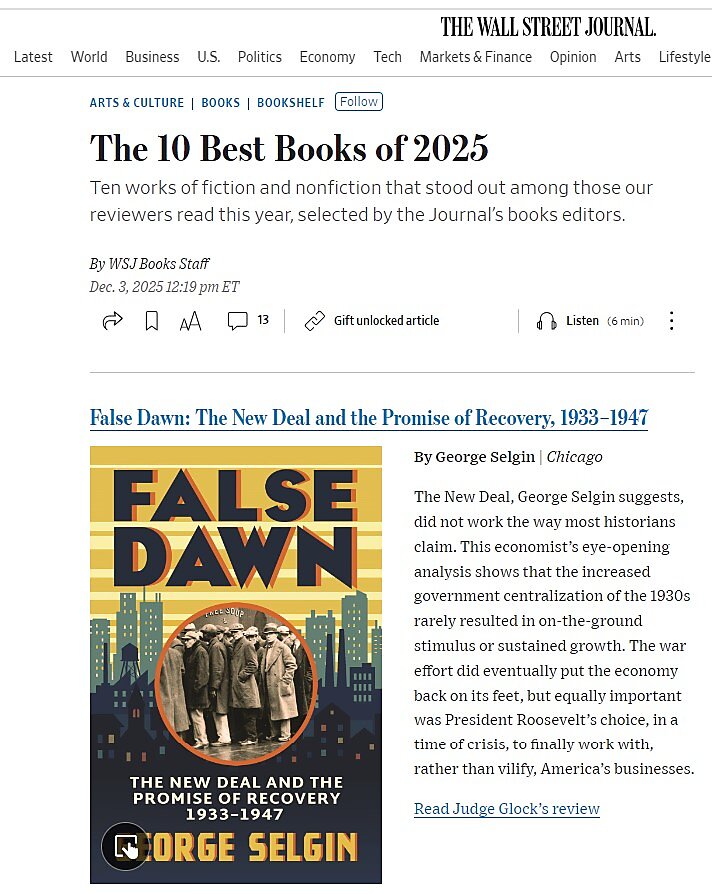
The ten best books of fiction and nonfiction from 2025 were selected by the Journal’s book editors. For False Dawn, the Journal wrote,
“The New Deal, George Selgin suggests, did not work the way most historians claim. This economist’s eye-opening analysis shows that the increased government centralization of the 1930s rarely resulted in on-the-ground stimulus or sustained growth. The war effort did eventually put the economy back on its feet, but equally important was President Roosevelt’s choice, in a time of crisis, to finally work with, rather than vilify, America’s businesses.”
In a June 15 review of the book, Judge Glock wrote in the Journal, “In dispassionate, careful, and finally devastating detail, False Dawn shows that, with a few exceptions, FDR’s experiments did not work…. Using decades of economic research, False Dawn should long remain the definitive word on the New Deal’s effectiveness.”
The University of Chicago Press, which published the book, notes that Selgin “draws on both contemporary sources and numerous studies by economic historians to show that” FDR’s actions raised hopes of a quick recovery from the Great Depression, but “subsequent New Deal policies proved so counterproductive that over seventeen percent of American workers—more than the peak unemployment rate during the COVID-19 crisis—were still either unemployed or on work relief six years later.”
Should America experience another severe downturn, like the Great Depression, policymakers and experts will “cast about for ways out,” says Selgin, and no doubt look to some of FDR’s policies. They would be wise, however, “to treat most of the New Deal episode as a warning about steps best avoided and to look elsewhere for better ones,” says the author.
Read an excerpt of False Dawn here.
Buy First Dawn here.
“Selgin mines a mountain of scholarship to prove this: New Deal measures failed to achieve, and often impeded, recovery from the Depression.” ― The Washington Post
“Norman Thomas, six-time presidential candidate of the American Socialist Party and for decades the second most popular speaker in America behind whoever was president, used to complain that the Democrats and FDR had stolen the Socialist Party Platform of 1928. Thomas was right. Read Selgin’s new book and learn why that was a false dawn for the US economy.” — Vernon Smith, Chapman University, winner of the Nobel Prize for Economics
“False Dawn is an extraordinary achievement. Economists, historians, and others have been researching the New Deal’s recovery programs and policies since the 1930s, but no one has ever done so as comprehensively and astutely as Selgin. False Dawn will be required reading for all who seek to understand how the New Deal affected the course of the Great Depression.” — Robert Higgs | author of Depression, War, and Cold War