
U.S. Government Officially Recognizes China’s Role in Burma Scam Centers


U.S. investigations into Southeast Asia’s online scam networks are expanding, with FBI Director Kash Patel accusing the Chinese Communist Party of supporting the construction of scam compounds in Myanmar and across the region that target Americans. The acknowledgment is significant not because the connection is new but because of its directness.
Treasury Department sanctions have already designated a number of Chinese entities and individuals, including She Zhijiang and Trans Asia, for involvement in the scam networks, meaning government awareness predates the public accusation. What has changed is the willingness to state it plainly.
These compounds operate under corporations headquartered in Yunnan province, Hong Kong, and Macau whose leadership has documented ties to the CCP and to local criminal networks.
She Zhijiang launched a $15 billion smart city project in Shwe Kokko in 2017, promoted by Xinhua as a model of China-Myanmar cooperation, with senior Chinese Embassy officials participating in the signing ceremony despite his criminal history. His Yatai International now hosts one of the region’s most infamous scam centers.
Wan Kuok-koi, a former Macau 14K Triad boss also known as Broken Tooth, established Dongmei Park in Myawaddy, which also hosts a scam center, in coordination with the Karen Border Guard Force, who provided security and territorial control.
A Border Guard Force is a junta-aligned ethnic militia that accepted nominal integration into Myanmar’s military structure under a 2009 program, retaining its weapons, commanders, and territorial control in exchange for formal subordination to the junta’s government in Naypyidaw.
The United States sanctioned Wan Kuok-koi, Dongmei Group, and the World Hongmen History and Culture Association, a united front-linked organization through which his CCP connections are documented, in 2020.
The Ming family operation in Laukkaing and KK Park, under the Karen National Army, round out the major compounds. The Karen National Army is a former Border Guard Force that cooperates with the Burma Army rather than the resistance.
Investigative reports indicate the compounds received funding, utilities, and telecommunications support from Chinese state-owned enterprises, and some syndicate leaders received praise in state media.
CCP tolerance, if not active protection, would have been a prerequisite for sustained operation at this scale.
One possible explanation for the centers’ emergence is that Belt and Road Initiative projects were halted during COVID, removing any conflict with state-sponsored investment projects and creating a vacuum the scam operations filled.
As Beijing’s domestic crackdowns made it more difficult to target people in China, criminal organizations converted empty hotels and casinos into compounds and shifted their focus to non-Chinese victims, particularly Americans.
Beijing appears to have believed it could shut the compounds down once it declared an end to COVID and investment activity resumed. The operators, however, had no incentive to comply, with revenues running into the billions.
In addition to fraud, the centers generate income through gambling, prostitution, drugs, weapons, endangered species trafficking, human trafficking, and online sexual content creation.
Hundreds of similar compounds operate across the broader region. The Ming family alone was charged with telecoms fraud, murder, illegal detention, extortion, running gambling dens, organizing prostitution, and drug trafficking.
The relationship between the CCP and the scam centers is better understood as the CCP having allowed these operations to develop rather than having built and directed them.
The centers initially targeted Chinese speakers because Mandarin is the lingua franca across large portions of Shan State and Chinese nationals were easy to recruit as operators.
As operations scaled and targeting shifted toward higher-income foreign victims, friction with Beijing’s interests grew. China is now attempting to suppress something it once tolerated, while operators whose profit motive dwarfs any alternative income source are fighting to survive.
Americans are among the primary targets because scams against Americans are unlikely to trigger a CCP response. They also represent a large, high-income pool of potential victims.
The United States ranks eighth globally in GDP per capita, behind only a handful of small, wealthy countries including Singapore, Norway, Brunei, Sweden, and Saudi Arabia.
However, the populations of those countries are much smaller than that of America, making the United States a smarter investment for the scam industry.
China has a larger population, and its middle class is tremendous. However, the average American holds roughly six to seven times the spending power of the average Chinese middle-class member.
English is a language the centers can staff relatively easily by trafficking Africans, Indians, and Filipinos, often through employment scams and offers of fake IT jobs.
The legal and jurisdictional complexity of prosecuting fraud committed abroad makes enforcement difficult. In many cases, because victims transfer money voluntarily, the transactions complicate prosecution even domestically.
China has taken a proactive role in jailing scammers, but its enforcement actions reflect several motivations beyond law enforcement. One is reputational: demonstrating action projects an image of responsible governance at a moment when Beijing is positioning itself favorably against U.S. military operations abroad.
A second is economic. Some compounds and the border guard forces controlling them obstruct Chinese investment corridors, pipelines, railways, and power lines that need to transit those areas, and where a scam operation controls territory that a Belt and Road project requires, Beijing has an incentive to remove it.
A third dynamic mirrors the logic of PLA purges: individuals who operated with apparent CCP tolerance have fallen out of political favor and are being removed for internal reasons.
Ethnic armed organizations have also handed Chinese nationals over to Beijing as a signal of alignment, expecting continued investment in return, and once those individuals are in Chinese custody, prosecution becomes necessary to maintain the appearance of principled action.
The FBI has launched a high-priority operation, established a complaint center for victims, and is working with regional governments to cut internet access to the compounds.
The Scam Center Strike Force, a multi-agency task force consisting of the Justice Department, Secret Service, State Department, FBI, and Homeland Security Investigations, is based in Thailand, where American personnel have embedded with the Royal Thai Police War Room Task Force. Raids have been conducted by Thai security personnel with U.S. personnel present as observers.
The operational limitation is jurisdictional: because the compounds sit on Burmese soil, neither the Thai nor U.S. governments have authority to hold seized locations, and raided centers typically reopen under new management.
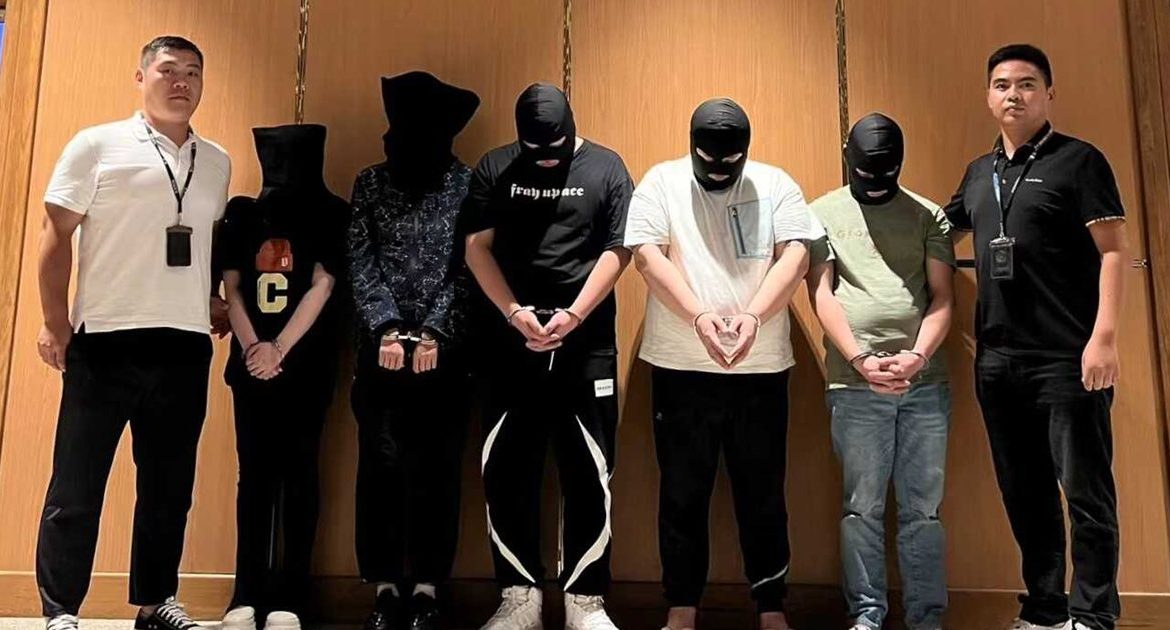
In Myanmar’s Karen State, 145 suspected Chinese scammers were detained in Myawaddy as part of a joint China-Myanmar-Thailand crackdown that has included demolishing structures at KK Park and Shwe Kokko, with China reporting more than 1,500 suspects repatriated under a trilateral mechanism launched in 2025.
If Beijing actually wanted to end the scam centers, there are many steps it could take. It could prosecute the corporate leadership headquartered in Yunnan, Hong Kong, and Macau rather than only repatriating low-level operators.
It could sanction or arrest She Zhijiang and Wan Kuok-koi’s networks at the source, rather than waiting for foreign governments to act first. It could cut off the state-owned enterprise support, funding, utilities, and telecommunications, that the compounds depend on to function.
It could stop state media from promoting BRI-linked projects like Shwe Kokko that provide cover for criminal infrastructure. It could pressure the Border Guard Forces and Karen National Army to evict the compounds entirely, rather than simply handing over selected individuals as diplomatic gestures.
It could allow or support U.S. and Thai jurisdiction to make arrests and hold seized locations permanently. It could cut off the movement of cash in and out of the scam centers, which use yuan-denominated transfers through Chinese money-laundering platforms.
The fact that China does not do this suggests that the regime is benefiting from the continued existence of the scam centers.
The post U.S. Government Officially Recognizes China’s Role in Burma Scam Centers appeared first on The Gateway Pundit.