
Iran’s Morality Police: Another Tool of Repression Under the Ayatollah


Iran has a religious government led by the ayatollah as supreme leader, the highest authority in the state. The country maintains two parallel military systems.
The Iranian army operates as the conventional national military, while the Islamic Revolutionary Guard Corps (IRGC) reports directly to the supreme leader, answerable only to him.
Domestically, the IRGC functions as a major tool of repression, including arresting and killing protesters.
Abroad, it supports terrorist organizations through training, funding, and coordination while carrying out the regime’s foreign policy objectives.
Law enforcement inside Iran operates through two parallel systems. The regular police force falls under the Law Enforcement Command of the Islamic Republic of Iran (FARAJA), which has more than 260,000 personnel and is under the direct control of the supreme leader, who serves as commander-in-chief of the armed forces.
Although FARAJA is administratively affiliated with the Interior Ministry, the minister is responsible only for logistical matters such as maintaining equipment and facilities.
The chief of staff of FARAJA is directly appointed by the supreme leader and in turn appoints the higher echelons of police officers.
The Office of the Representative of the Supreme Leader within the force is responsible for indoctrinating police personnel. The elected president and parliament have no authority to appoint or dismiss the police commander
. In December 2021, Khamenei issued a decree elevating FARAJA’s structure to that of a General Command, raising it to the same rank as the army and the IRGC and further consolidating the supreme leader’s control over the repression apparatus.
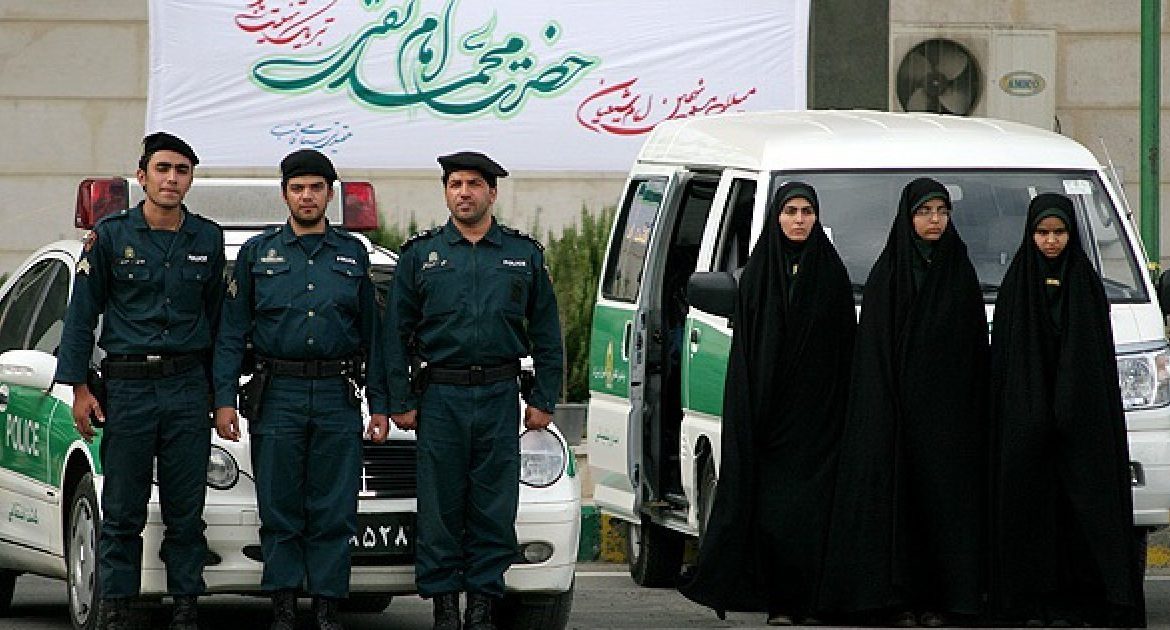
Alongside the regular police operates Iran’s morality police, formally known as the Gasht-e Ershad, or Guidance Patrol, an Islamic religious police unit tasked with enforcing the regime’s strict interpretation of Islamic social codes, with particular focus on mandatory hijab for women.
After the relatively more open era of President Mohammad Khatami (1997–2005), the conservative government of President Mahmoud Ahmadinejad established the Gasht-e Ershad in 2005 as a specialized patrol squad within FARAJA, succeeding the Islamic Revolution Committees.
Its creation followed a resolution by Iran’s Supreme Council of Cultural Revolution on “strategies to develop a culture of chastity.” By 2005, the force already consisted of more than 7,000 officers.
Women make up less than a quarter of the unit and frequently accompany their male counterparts, who often arrive in unmarked vans.
In its early years, members were largely religiously devout followers of the regime who joined at the encouragement of clerics; when Ahmadinejad formalized the force, a number of young men also joined to fulfill mandatory military conscription requirements.
The Guidance Patrol reports directly to the supreme leader and operates under the authority of FARAJA’s commander to conduct street-level interventions aimed at promoting virtue and preventing vice.
Officers have authority to issue verbal warnings, detain women on the street for noncompliant dress, transport detainees to processing centers, refer cases to prosecutors and courts for criminal charges, fine individuals, seize vehicles, and close businesses that fail to enforce compliance. Fines are automatically deducted from citizens’ bank accounts.
Guidance patrols typically consist of a van with a male crew accompanied by women in chadors, a full-length open cloak that covers the head and body but leaves the face fully visible.
They are stationed at busy public places such as shopping centers, squares, and subway stations, sometimes assisted by Basij paramilitary volunteers, who regularly supplement FARAJA patrols at public spaces, universities, and mass gatherings.
The unit’s structure enables routine coordination with the IRGC and its Basij wing through shared ideological oversight and personnel overlap.
The Basij is a paramilitary volunteer militia operating under the command of the IRGC. It was founded by Ayatollah Khomeini in 1979 shortly after the Islamic Revolution.
In January 2023, Supreme Leader Khamenei appointed Ahmad-Reza Radan as commander of FARAJA. Radan began his career in the Basij and the IRGC, served as a provincial commander in Kurdistan, Sistan and Baluchestan, Khorasan Razavi, and Tehran, and was one of the architects of the morality police program in 2005.
He was sanctioned by the United States in 2010 and the European Union in 2011 for human rights violations and was dispatched to Syria in 2011 to advise the Assad government on crackdown tactics.
Overall coordination of the security apparatus is carried out by the Supreme National Security Council, headed by the supreme leader and including the president, the interior minister, commanders of relevant organizations, and the heads of the legislature and judiciary.
It is this council that decides how to respond when protests break out, with each province maintaining its own security council to implement nationwide crackdowns on the ground.
One of the more recent focuses of the morality police has been the enforcement of the Noor Plan. Noor, meaning “light” in Persian, is a state-run enforcement campaign launched by FARAJA.
On April 3, 2024, Supreme Leader Khamenei gave a speech emphasizing that the government and judiciary have a legal obligation to enforce mandatory hijab laws and that all women and girls, regardless of religion or belief, are legally required to comply.
Ten days later, Tehran police commander Abbas Ali Mohammadian announced the launch of the plan.
At the same time, the IRGC commander for Tehran announced the deployment of trained civilian groups called “ambassadors of kindness,” tasked with monitoring hijab compliance in public spaces such as markets, parks, and public transit.
The plan deploys police officers across all Iranian provinces to confront individuals appearing without the hijab. Women typically receive an initial warning, followed by possible legal action for repeat violations.
Enforcement relies heavily on surveillance technology, including drones, facial-recognition software, and street cameras.
Facial-recognition systems have been installed at locations such as the entrance to Tehran’s Amirkabir University, while roadway cameras scan for violations in passing vehicles.
Authorities also introduced the “Nazer” mobile app, allowing members of the public to report suspected hijab violations in vehicles by submitting the location, date, time, and license plate number. Reports trigger alerts to police, and vehicles can be flagged or confiscated.
The Noor Plan functions as the enforcement arm of a broader legal framework. The December 2024 Hijab and Chastity Law, a 71-article measure approved by parliament and the Guardian Council, expanded the authority of the Intelligence Ministry, the IRGC, police, and judiciary to identify and prosecute violations.
The law directs FARAJA to use traffic cameras and artificial intelligence to identify offenders and authorizes penalties for businesses and institutions that fail to enforce compliance.
Iran’s legal system has been fully unified under Islamic law since the 1979 revolution. The entire penal code, including Hudud offenses, ta’zir discretionary punishments, and qisas (retribution), is Sharia-based and administered through a single court system.
Morality-police detentions are typically short-term. A woman detained for hijab noncompliance is usually held briefly, forced to sign a commitment to comply, and released, sometimes after a family member retrieves her.
However, a morality-police arrest can serve as the entry point into a legal system capable of holding someone indefinitely.
The catch-all charges of moharebeh (“waging war against God”) and mofsed-e-filarz (“spreading corruption on earth”) carry no fixed sentence, giving judges broad discretion.
Political prisoners, journalists, activists, and repeat offenders referred to the courts are often held under these charges for indeterminate periods, with no clear release date, through prosecutorial and judicial discretion rather than any separate court structure.
Democrat lawmakers and their liberal allies should read Iranian law before claiming that President Trump is not liberating Iranians by freeing them from the ayatollah, the IRGC, and the morality police.
The post Iran’s Morality Police: Another Tool of Repression Under the Ayatollah appeared first on The Gateway Pundit.