
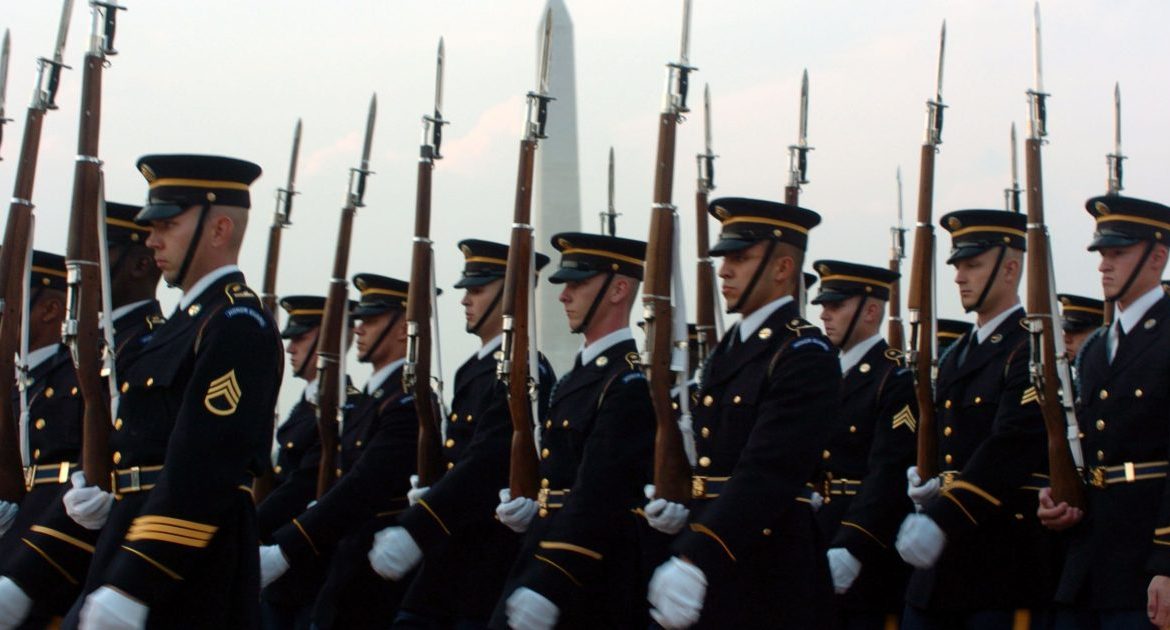
Who Really Fights America’s Wars? The Military’s Republican Majority


As President Trump has successfully brought about regime change in Venezuela and eliminated Iran’s Supreme Leader Ayatollah Khamenei, liberals on social media are urging Republicans, “If you support Trump’s wars, go join the Army.”
But the data show that Republicans serve in the military at a much higher rate than Democrats. Consequently, the political party that largely supports Trump’s actions is the same party standing on the front lines.
Liberals are quick to criticize Trump’s lack of military service, but no Democrat president has been a veteran since 1979.
Jimmy Carter served in the U.S. Navy as a submarine officer from 1946 to 1953 and was the last Democrat president to have served in the military.
Bill Clinton had no military service and notably avoided the draft during Vietnam, which became a significant political controversy. Barack Obama had no military service. Joe Biden received five deferments from the Vietnam-era draft and was classified 1-Y due to asthma, effectively draft-exempt.
Republicans, by contrast, include Ronald Reagan, who served in the U.S. Army Air Forces from 1937 to 1945 and reached the rank of Captain.
George H.W. Bush was a U.S. Navy aviator and decorated combat veteran of World War II, the youngest naval aviator at the time of commissioning, and was shot down in combat over the Pacific. George W. Bush served in the Texas Air National Guard as an F-102 pilot from 1968 to 1973.
Donald Trump had no active military service and received deferments, including a medical deferment for bone spurs. However, he graduated from New York Military Academy in Cornwall-on-Hudson, New York.
He enrolled in 1959 at age 13, graduated in 1964, and rose to the rank of Student Captain, the highest rank available to cadets, commanding the entire corps of cadets in his final year.
In recent Congresses, Republicans have consistently had higher rates of military veterans among their members than Democrats. Of the 80 veterans in the House, 62 are Republicans and 18 are Democrats, meaning Republicans make up 77.5% of House veterans while Democrats make up 22.5%.
Of the 17 veterans in the Senate, 10 are Republicans and seven are Democrats, meaning Republicans make up about 58.8% of Senate veterans while Democrats make up about 41.2%. The trend of Democrats having fewer veterans in Congress has accelerated since roughly 2000.
A number of pro-Iran protesters, as well as liberals and Democrats who oppose the U.S. striking Iran, toppling the regime, and moving the Iranian people closer to liberation than they have been in decades, argue that MAGA supporters who back the war should have to fight in it. The short answer is that MAGA is already fighting in the war.
Republicans outnumber Democrats in the active-duty military, and Gallup and Pew Research data consistently show that veterans vote Republican at significantly higher rates.
Active-duty enlisted personnel demonstrate a 1.7-to-1 Republican-to-Democrat partisan ratio, and enlisted personnel are about three times more likely to identify as independents compared to civilians. According to Pew Research, about 63% of veterans lean toward the Republican Party.
Many assume that the Marine Corps and the Army would be the most conservative branches, with the Navy and Air Force coming last.
However, using Federal Election Commission aggregated data on contributions to political parties, the Marines and the Air Force tend to be significantly more conservative than the Navy and the Army.
The ranking, based on FEC data, appears to be Marines most conservative, Air Force second most conservative, Army less conservative than expected, and Navy least conservative.
There is also a significant difference in party affiliation between enlisted personnel and officers. About two-thirds of majors and higher-ranking officers identify as conservative.
However, only 32% of Army enlisted soldiers consider themselves conservative, while 23% identify as liberal and the remaining 45% are self-described moderates.
Two out of three officers consider themselves either Republican or Democrat, but only 37% of enlisted personnel do so. Officers tend to be not only more partisan but also more Republican, with GOP affinity strongest among the highest ranks.
The Marines’ conservative lean can be explained by several structural factors. It is the smallest branch and the most selective, with the highest standards.
It has the strongest institutional culture and places heavy emphasis on unit cohesion. The Marines recruit heavily from rural Southern and Midwestern communities.
The culture emphasizes traditional values, discipline, and hierarchy. Historically, it has had lower minority representation than the Army. Its combat infantry focus also attracts a specific demographic profile.
The Army ranks lower than expected largely because it is the largest branch and therefore the most demographically diverse. It has a higher proportion of minority enlisted personnel, who statistically lean more Democratic.
The Army also draws from a broader geographic recruiting pool rather than concentrating heavily in traditionally conservative regions. In addition, it includes far more administrative and support roles, which reduces the self-selection effect seen in combat-oriented branches that tend to attract a narrower demographic profile.
The post Who Really Fights America’s Wars? The Military’s Republican Majority appeared first on The Gateway Pundit.