
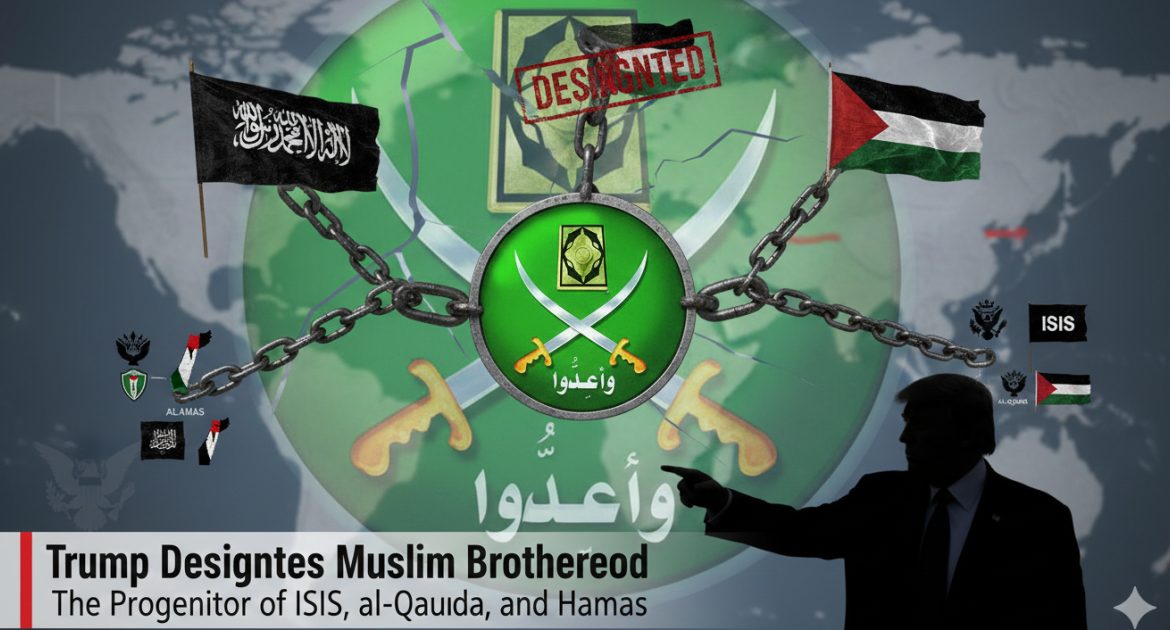
Trump Designates Branches of Muslim Brotherhood as Terrorist Organizations – The Progenitor of ISIS, al-Qaeda, and Hamas


President Trump has taken a bold stance that no previous president has. He has designated branches of the Muslim Brotherhood as terrorist organizations. This designation should have been made decades ago, as the Muslim Brotherhood is considered by many experts to be the progenitor of ISIS, al-Qaeda, Hamas, and other terrorist organizations.
Founded in 1928 by Hassan al-Banna, the Muslim Brotherhood has branches and affiliated political parties across the Middle East. The Lebanese branch holds seats in parliament and in 2024 supported Hezbollah’s “support front” against Israel. In Jordan, the group’s political arm won 31 House of Representatives seats in the 2024 elections before the organization was banned over alleged links to a sabotage plot.
In Egypt, the Brotherhood won the country’s 2012 presidential election, but President Mohamed Morsi was overthrown in 2013 and later died in custody.
The Brotherhood presents itself as a political movement, yet its core ideas laid the foundation for modern jihadist groups. The claim that it is the “mother of all Islamist movements” rests on three pillars: ideology, personnel, and strategy. The most significant ideological link is the work of Sayyid Qutb, a leading Brotherhood ideologue executed in 1966.
In his book Milestones, he advanced two concepts that became central to jihadist doctrine: jahiliyyah, the idea that modern society, including Muslim-majority countries, had reverted to a state of pre-Islamic ignorance and was therefore un-Islamic, and takfir, the practice of declaring other Muslims apostates, providing a religious justification for killing them. These concepts later formed the foundation of the Salafi-jihadist ideology adopted by al-Qaeda and ISIS.
Many prominent terrorists began their involvement in Islamist movements within the Muslim Brotherhood before moving to more violent organizations. Osama bin Laden joined the Brotherhood in his youth in Saudi Arabia. Ayman al-Zawahiri, a former leader of al-Qaeda, was a member of the Egyptian Brotherhood before forming Egyptian Islamic Jihad. Abu Bakr al-Baghdadi, the former ISIS leader, was associated with the Brotherhood in Iraq during his university years. Khalid Sheikh Mohammed, the architect of the September 11 attacks, joined the Brotherhood in Kuwait at age 16.
Hamas represents a direct institutional link as an official offshoot of the Muslim Brotherhood. Article 2 of the Hamas Covenant states, “The Islamic Resistance Movement is one of the wings of the Muslim Brotherhood in Palestine.” Because Hamas has carried out suicide bombings and targeted attacks on civilians, critics argue that this relationship undermines the Brotherhood’s claim to be solely a political or social movement.
On January 13, 2026, the U.S. Department of the Treasury’s Office of Foreign Assets Control, in coordination with the Department of State, designated the Egyptian and Jordanian branches of the Muslim Brotherhood as Specially Designated Global Terrorists under Executive Order 13224, as amended. In a concurrent action, the State Department designated the Lebanese branch, al-Jamaa al-Islamiyah, as both a Foreign Terrorist Organization under section 219 of the Immigration and Nationality Act and a Specially Designated Global Terrorist, and also designated its Secretary General, Muhammad Fawzi Taqqosh, as a Specially Designated Global Terrorist.
These measures follow President Trump’s November executive order directing the administration to begin blacklisting certain Muslim Brotherhood chapters and are consistent with Executive Order 14362, issued November 24, 2025. The administration stated that the designations are part of a broader effort to counter what it describes as the Brotherhood’s support for terrorism, particularly its backing of Hamas and activities targeting US and Israeli interests.
Secretary of the Treasury Scott Bessent said the action was taken under President Trump’s leadership to cut the organizations off from the financial system. Under Secretary for Terrorism and Financial Intelligence John K. Hurley stated that the branches had conspired to support Hamas and undermine their own governments. The administration described the measures as the first phase of an ongoing effort to address Muslim Brotherhood-linked violence and destabilization.
According to the Treasury Department, Brotherhood branches have provided material support to Hamas, which it described as inspired by and serving as a branch of the Brotherhood. In 2025, the Egyptian Muslim Brotherhood reportedly coordinated with Hamas on potential terrorist activities targeting Israeli interests and worked with Hamas’s military wing to destabilize the Egyptian government. In 2024, individuals seeking to travel to Gaza to fight for Hamas allegedly relied on Brotherhood connections in Egypt to facilitate entry, while fundraising efforts linked to members supported Hamas militants.
Elements connected to the Jordanian Muslim Brotherhood, dissolved by judicial verdict in 2020, were involved in terrorism cases in Jordan in 2025, including manufacturing rockets, explosives, and drones, as well as recruitment and fundraising through illegal means. Both the Egyptian and Jordanian branches were designated for materially assisting, sponsoring, or providing financial, material, or technological support to Hamas.
Many of Iran’s revolutionary leaders, including Supreme Leader Khamenei, were influenced by the writings of Muslim Brotherhood ideologues such as Sayyid Qutb.
The designation has implications for ongoing U.S.-Iran nuclear talks. Despite sectarian differences, elements of the Muslim Brotherhood and Iran have at times coordinated logistics and media efforts in opposition to shared adversaries. Iran funds and trains Hamas, and has reportedly increased coordination with the Lebanese Brotherhood in the context of tensions with Israel.
US intelligence reporting has also cited instances in which Iran-backed groups, including Hezbollah, and Muslim Brotherhood-linked networks have cooperated in the Levant in what officials have described as “battlefield coordination.”
Salah Abdel Haq, acting general guide of the Egyptian Muslim Brotherhood, rejected the US designation and said the group would pursue legal avenues to challenge it. He denied that the organization had directed, funded, or supported terrorism and suggested the decision reflected pressure from Israel and the United Arab Emirates rather than an objective US assessment. Egypt’s Foreign Ministry welcomed the designation, calling it a pivotal step that reflects what it described as the group’s extremist ideology and threat to regional security.
The designations make it illegal to provide material support to the named groups and impose economic sanctions. The Foreign Terrorist Organization label also bars members from entering the United States. In the United States, some Republican governors moved to designate the Council on American-Islamic Relations alongside the Muslim Brotherhood as terrorist groups, prompting CAIR to file lawsuits denying any links to the organization.
As a result of the designations, all property and interests in property of the designated persons within the United States or under the control of U.S. persons are blocked and must be reported to OFAC. Entities owned 50 percent or more by designated persons are also blocked. U.S. persons are generally prohibited from engaging in transactions involving blocked property unless authorized by OFAC.
Violations may result in civil or criminal penalties, and foreign financial institutions may face secondary sanctions for conducting significant transactions on behalf of designated persons. The release states that sanctions are intended to bring about behavioral change and provides information on how designated persons may seek removal from the SDN List.
The post Trump Designates Branches of Muslim Brotherhood as Terrorist Organizations – The Progenitor of ISIS, al-Qaeda, and Hamas appeared first on The Gateway Pundit.