
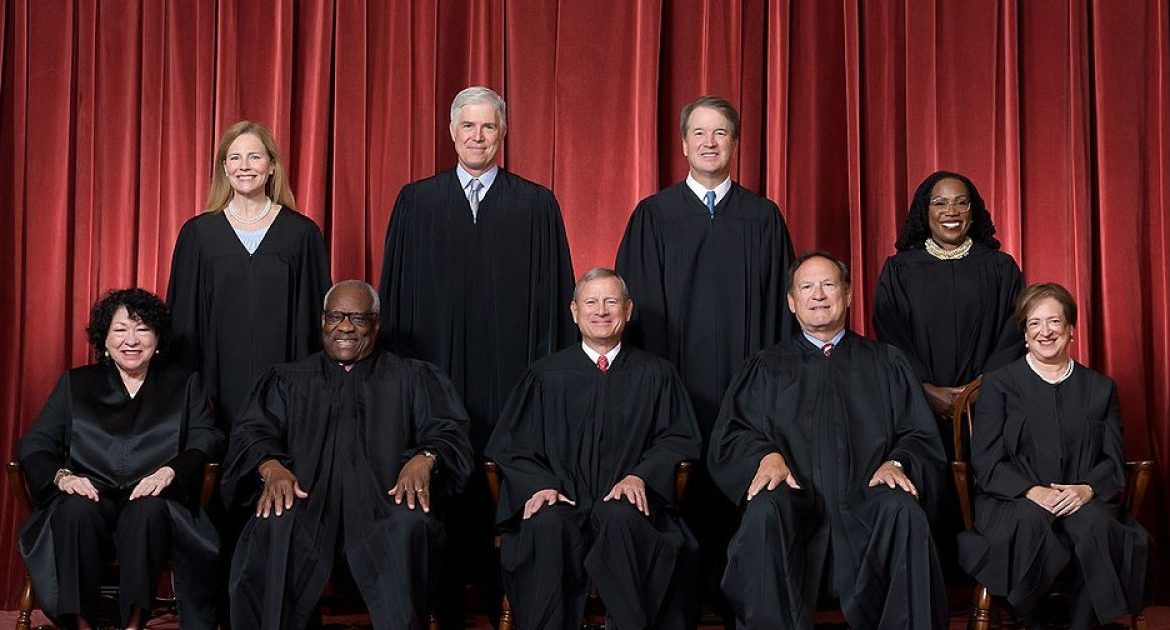
Three Justices WARN Majority Is Handcuffing President Trump’s Ability to Fight Foreign Threats — Here’s What the Three Justices Said in Their Dissent


The Supreme Court has struck down President Trump’s boldest efforts to secure our borders and rebuild the American middle class.
Led by Chief Justice John Roberts, who once again sided with the liberal wing and a handful of “major questions” obsessives, the Court ruled that the President does NOT have the authority under the International Emergency Economic Powers Act (IEEPA) to impose tariffs on foreign nations that are flooding our streets with drugs and hollowing out our factories.
Three lone voices of sanity, Justices Kavanaugh, Thomas, and Alito, issued a blistering dissent, warning that this decision creates a “mess” of biblical proportions for the U.S. Treasury and leaves our national security vulnerable to foreign threats.
These justices called out the decision as a dangerous power grab by the judiciary, ignoring historical precedents and the clear intent of Congress to empower the President in times of emergency.
President Trump, shortly after reclaiming the White House in 2025, declared national emergencies over the “public health crisis” caused by illegal drugs pouring in from Canada, Mexico, and China, and the “hollowing out” of American manufacturing due to massive trade deficits.
Using IEEPA, a law passed in 1977 to give presidents tools to fight foreign threats, he slapped tariffs on imports: 25% on most Canadian and Mexican goods, 10% on Chinese products for the drug war, and at least 10% on ALL imports from trading partners to fix the trade imbalance.
Small businesses and deep-state allies sued, and today the Court sided with them, claiming IEEPA’s language to “regulate… importation” doesn’t include tariffs because it’s not “clear congressional authorization.”
Roberts, joined by the usual suspects (Sotomayor, Kagan, Jackson) and turncoat Barrett and Gorsuch, invoked the so-called “major questions doctrine” to block Trump’s America-First agenda.
They argued tariffs are a “taxing power” reserved for Congress, ignoring that emergencies demand swift action from the Commander-in-Chief.
Justice Samuel Alito didn’t write separately but joined Kavanaugh’s dissent in full, signaling his full-throated agreement that this ruling is a dangerous overstep.
Alito, known for his no-nonsense defense of executive authority in national security matters, clearly sees this as another liberal power grab that weakens America’s defenses.
Key Quotes from Justice Kavanaugh (Joined by Thomas and Alito)
Justice Kavanaugh’s dissent focused on the statutory text and the historical understanding of the President’s role in foreign affairs:
-
On Statutory Authority: “In light of the statutory text, longstanding historical practice, and relevant Supreme Court precedents, I would conclude that IEEPA authorizes the President to ‘regulate . . . importation’ by imposing tariffs on foreign imports during declared national emergencies”.
-
On the Majority’s Reasoning: “The Court’s decision today cannot be justified as a matter of statutory interpretation”.
-
On the Major Questions Doctrine: “What is new and rather extraordinary is the approach embodied in THE CHIEF JUSTICE’s opinion for three Justices, which would extend the major questions doctrine into the foreign affairs realm for the first time”.
-
On Practical Consequences: “The United States may be required to refund billions of dollars to importers who paid the IEEPA tariffs… the refund process is likely to be a ‘mess’” .
-
On Global Uncertainty: “Because IEEPA tariffs have helped facilitate trade deals worth trillions of dollars—including with foreign nations from China to the United Kingdom to Japan… the Court’s decision could generate uncertainty regarding various trade agreements.”
Key Quotes from Justice Thomas’s Separate Dissent
Justice Thomas went further in his separate opinion, arguing that the “core legislative power” was not at stake because importing is not a “core private right”:
-
On the Nature of Importing: “Importing is a matter of privilege” and “A person had no core private right to import goods at the founding”.
-
On the Nondelegation Doctrine: “the nondelegation doctrine does not apply to ‘a delegation of power to make rules governing private conduct in the area of foreign trade,’ including rules imposing duties on imports”.
-
On Separation of Powers: “Therefore, to the extent that the Court relies on ‘“separation of powers principles”’ to rule against the President… it is mistaken”.
-
On Historical Precedent: “Early Congresses often delegated to the President power to regulate foreign commerce, including through duties on imports”.
More from Thomas via Eric Daugherty:
“NEITHER the statutory text nor the Constitution provide a basis for ruling against the President.”
“Congress authorized the President to “regulate . . . importation.” Throughout American history, the authority to “regulate importation” has been understood to include the authority to impose duties on imports.”
“The meaning of that phrase was beyond doubt by the time that Congress enacted this statute, shortly after President Nixon’s highly publicized duties on imports were UPHELD based on identical language.”
“The statute that the President relied on therefore authorized him to impose the duties on imports at issue in these cases.”
“Because the Constitution assigns Congress many powers that do not implicate the nondelegation doctrine, Congress may delegate the exercise of many powers to the President.”
“Congress has done so repeatedly since the founding, WITH THIS COURT’S BLESSING.”
Read the ruling below:
The post Three Justices WARN Majority Is Handcuffing President Trump’s Ability to Fight Foreign Threats — Here’s What the Three Justices Said in Their Dissent appeared first on The Gateway Pundit.