
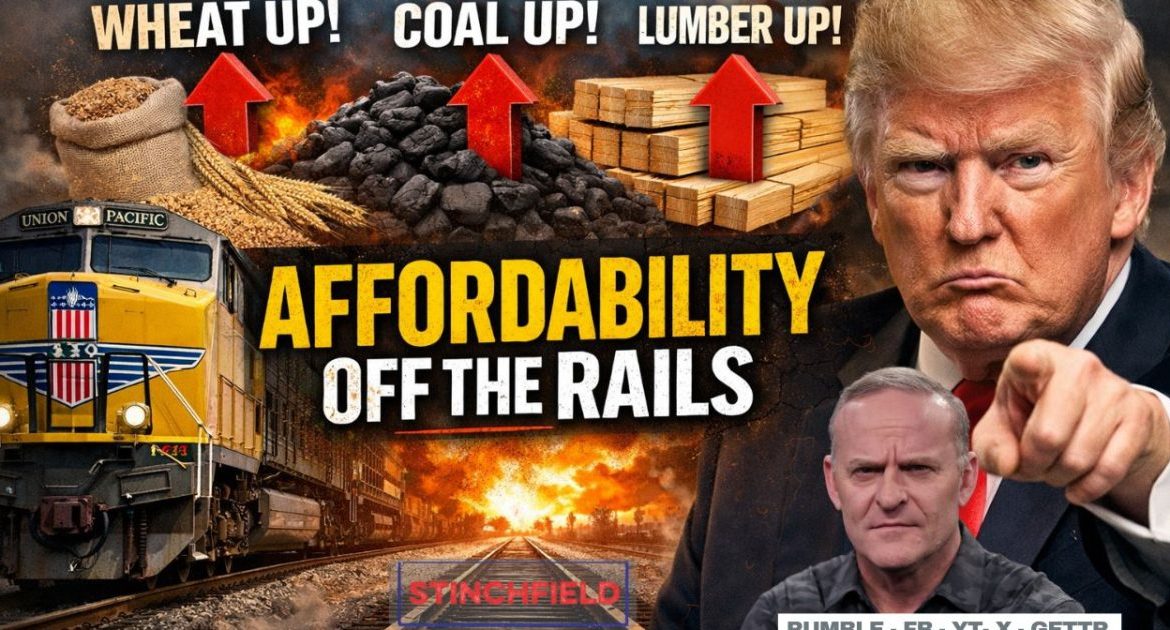
Trump’s America First Agenda Can’t Afford a Rail Monopoly (VIDEO)


President Trump’s economic vision has centered on a simple but powerful idea, make life more affordable for American families by restoring competition, strengthening supply chains, and putting domestic production first.
That vision depends on markets that are dynamic and competitive, not dominated by a handful of massive players with the power to dictate terms.
That is why the proposed merger between two of the nation’s largest railroad companies, Union Pacific and Norfolk Southern, deserves serious scrutiny and ultimately should be denied.
At first glance, a railroad merger may sound like an obscure issue far removed from kitchen-table concerns. It is anything but. Railroads are one of the most critical arteries of the American economy.
They move the grain harvested by our farmers, the coal and energy products that keep the lights on, the automobiles assembled in American plants, and the raw materials used to build homes, roads, and infrastructure. When rail transportation becomes more expensive or less efficient, the cost of nearly every product Americans buy spikes.
History teaches us that large-scale consolidation, like the merger proposed, rarely delivers the promised savings to consumers. Instead, it always leads to reduced competition, fewer choices for shippers, and increased pricing power concentrated in the hands of a single entity. This is the opposite of President Trump’s free market vision for American savings.
This proposed deal would create a transcontinental rail system of unprecedented scale. A mega-network capable of dominating vast shipping corridors with limited competitive pressure. That is not the kind of environment that produces lower costs or better service. It is the kind of environment where prices quietly rise and accountability diminishes.
The Surface Transportation Board is tasked with reviewing this proposed mega merger, and it exists precisely to prevent that outcome. Its statutory responsibility is to determine whether a transaction enhances competition and serves the public interest.
Any merger that reduces competitive access to rail service must be denied. The Union Pacific – Norfolk Southern deal, if approved, would be a costly blow to the nation’s economic resurgence we are experiencing right now.
By consolidating two major carriers into a single coast-to-coast powerhouse, the merger would eliminate key areas where railroads currently must compete for business. Today, many agricultural producers, manufacturers, and energy suppliers can negotiate rates or routes among multiple carriers.
Under a merged system, those options could shrink dramatically, leaving shippers with fewer alternatives and less leverage. And when businesses lose leverage, consumers eventually lose money.
Vice President J.D. Vance summarized the broader danger succinctly: “When you have one or two companies dominating an entire sector, it’s bad for liberty and it’s bad for prosperity.” That warning reflects a long-standing conservative understanding that concentrated economic power, whether public or private, undermines the freedom and innovation that drive American growth.
Free markets are not defined by size alone. They are defined by competition.
One of the most striking aspects of the opposition to this merger is the coalition forming against it. In an era when Washington struggles to agree on even routine matters, lawmakers from sharply different political perspectives are raising the same concerns.
MAGA firebrand Senators Jim Banks and Tim Sheehy, strong advocates of market-driven growth, have found common ground with far left Democrats such as Raphael Warnock and Dick Durbin. These lawmakers disagree on many policy questions, yet they recognize that excessive consolidation in freight rail threatens the competitive balance that both parties claim to value. When such an unlikely alliance emerges, Americans should take notice.
The stakes are especially high for rural America. Farmers depend heavily on rail to bring crops to market. With tight margins already shaped by weather, fuel costs, and global price swings, even modest increases in transportation rates can mean the difference between profit and loss. A larger, less competitive railroad system could impose exactly those kinds of increases.
Manufacturers face similar risks. Rail is often the most cost-effective way to move heavy inputs like steel, chemicals, and industrial components. Reduced competition could translate into higher shipping costs, less flexible service, and slower delivery times—all of which work against efforts to rebuild American manufacturing.
Energy markets would feel the impact as well. Bulk commodities such as coal, ethanol, and other fuels rely on dependable rail access. When transportation costs climb, utility prices and energy bills often follow. In every case the consumer loses.
In short, this merger could act as a nationwide cost increase disguised as corporate efficiency.
At a moment when policymakers say they want to combat inflation, secure supply chains, and make American goods more affordable, approving a consolidation of this magnitude would send the wrong signal. It would reward scale over competition and concentration over resilience.
America’s economic strength has always come from rivalry, companies striving to outperform one another, win customers, and innovate. The rail industry should be no exception.
The Surface Transportation Board should uphold its mandate, protect competitive access to the nation’s freight network, and reject this merger. Doing so would not be anti-business. It would be pro-consumer, pro-competition, and most importantly pro-America.
Competition built this country. Preserving it is how we keep it strong.
The post Trump’s America First Agenda Can’t Afford a Rail Monopoly (VIDEO) appeared first on The Gateway Pundit.