
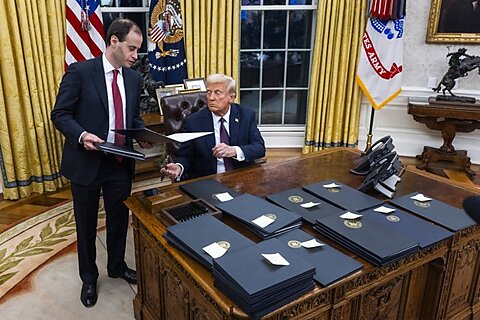
Donald Trump has been a frequent user of the presidential pardon power. The power can be used beneficially to correct miscarriages of justice. But the president appears to be using it to reward friends and political allies.
This post examines Trump’s pardons of individuals convicted of public corruption, which generally involves elected and career officials stealing public funds or accepting bribes to hand out government benefits.
Most federal, state, and local public corruption cases are prosecuted by US attorneys and the Department of Justice (DOJ), and so Trump’s pardons are releasing from prison corrupt officials from all levels of government. Some background on public corruption is here, here, and here.
Trump’s pardons are troubling because jailing corrupt officials deters public-sector crime. The president’s downsizing of the DOJ’s public integrity section is also a concern. Attorney Liz Oyer argues that Trump is “normalizing public corruption by liberally pardoning corrupt public officials who are charged with offenses that involve abusing their political offices to enrich themselves.”
Let’s look at some of Trump’s pardons and commutations of corrupt public officials.
- Rod Blagojevich. The former Illinois governor was convicted in 2011 on 17 counts of corruption after running for office promising to end “pay to play” politics. Blagojevich attempted to “illegally trade the appointment of a United States Senator in exchange for $1.5 million in campaign contributions.” He also tried to extort bribes from a hospital and the racetrack industry in exchange for policy actions. Trump commuted his 14-year prison sentence during his first term and then gave him a full pardon in 2025. Trump had long known Blagojevich and called him “a very nice person,” but Illinois leaders were appalled by the commutation and the pardon.

- Scott Jenkins. The former sheriff of Culpeper County, Virginia, was convicted in 2024 of accepting more than $75,000 in bribes to appoint eight people as auxiliary deputy sheriffs. Jenkins was sentenced to 10 years in prison, but Trump pardoned him in 2025. Trump said that Trump-supporter Jenkins is a “wonderful person,” but the jury had a different view.
- Glen Casada. The former Tennessee House Speaker and his chief of staff, Cade Cothren, were sentenced in 2025 to prison for corruption-related offenses. Cothren set up a company under an alias, and then, in return for kickbacks, Casada and legislator Robin Smith steered the company’s contracts. The conspirators falsified documents and gained more than $50,000 in state funds and $159,000 in caucus and campaign funds. Trump granted Casada and Cothren pardons in November.
- George Santos. The former congressman was convicted in 2024 and sentenced to seven years in prison. Santos “filed fraudulent FEC reports, embezzled funds from campaign donors, charged credit cards without authorization, stole identities, obtained unemployment benefits through fraud, and lied in reports to the House of Representatives.” Trump commuted his sentence in 2025, writing, “Santos had the Courage, Conviction, and Intelligence to ALWAYS VOTE REPUBLICAN!”

- Alexander Sittenfeld. The former Cincinnati city council member was convicted of corruption-related offenses and sentenced in 2023 to 16 months in prison. Sittenfeld shook down businesses that wanted real estate approvals and other benefits from the city. Trump pardoned him in 2025.
- Duncan Hunter. The former congressman and “fervent Trump supporter” from California was sentenced in 2020 to 11 months in prison for stealing $250,000 in campaign funds. For years, Hunter illegally used campaign funds to pay for personal expenses. Trump pardoned him in 2020.
- Michele Fiore. The former Las Vegas city council member spent $70,000 that was meant for building a police memorial on personal expenses. Fiore was convicted in 2024 but pardoned by Trump in 2025. Fiore’s nickname was “Lady Trump” for her populist style.

- Henry Cuellar. The congressman from Texas was indicted in 2024 on corruption charges. He was alleged to have “accepted nearly $600,000 in bribes from an Azerbaijan-controlled energy company and a bank in Mexico, and in exchange, Cuellar agreed to advance the interests of the country and the bank in the U.S.” Trump pardoned Cuellar in 2025, apparently because he was supportive on border policies and Trump expected him to switch political parties.
- Jeremy Hutchinson: The former Arkansas state senator was sentenced in 2023 to eight years in prison for accepting bribes for official acts, including aiding a healthcare company. The company paid Hutchinson more than $350,000 from 2014 to 2017. Nine other government and company officials were convicted in the scandal. Trump pardoned Hutchinson in 2025.
- Rick Renzi. The former House member from Arizona was convicted in 2013 on 17 counts, including racketeering, bribery, and money laundering. In addition to an insurance fraud scheme, Renzi helped engineer a federal land swap that pocketed him $700,000. Renzi was sentenced to three years in prison. Trump pardoned him in 2021.
- Kwame Kilpatrick. The former Detroit mayor was convicted in 2013 on “two dozen counts that included charges of racketeering and extortion, adding his name to a list of at least 18 city officials who have been convicted of corruption during his tenure.” Kilpatrick created a pay-to-play system “that made breaking the law standard operating procedure. Kilpatrick extorted city vendors, rigged bids, and took bribes. He used funds from nonprofit civic organizations to line his pockets.” Prosecutors said that he “systematically exploited his office to enrich himself, his friends, and his family.” Trump commuted Kilpatrick’s 28-year prison sentence in 2021.

- Steve Stockman. The former Texas congressman was convicted in 2018 of 23 corruption-related counts. He raised more than $1 million for charitable projects that he actually spent on campaign and personal expenses. He was sentenced to 10 years in prison, but Trump commuted the sentence in 2020.
Trump is not the only president who has used the pardon power in idiosyncratic ways, thus undermining equal treatment and trust in government. President Joe Biden pardoned his son for gun and tax crimes after he repeatedly said that he would not, a move that just 20 percent of Americans approved of.
Biden also let off numerous corrupt officials. He commuted the sentence of Jimmy Dimora, an Ohio county commissioner convicted of accepting $166,000 in bribes in exchange for various government favors. He commuted the sentence of Pennsylvania judge Michael Conahan, who was convicted of taking $2 million in kickbacks for sending kids to certain private detention centers. And he commuted the sentence of Rita Crundwell, the former comptroller of Dixon, Illinois, who stole a massive $54 million of public money to fund a lavish lifestyle.
These actions by Trump and Biden are an injustice. We already have too many politicians who seem to think that public office is a springboard to personal riches rather than an opportunity to serve the community. We don’t want people pursuing political careers thinking that it’s okay to line their pockets on the side. If presidents routinely spring crooked officials from jail, it signals that public corruption is no big deal, and we will get more of it.
Cato’s Dan Greenberg provides a broader view of Trump’s pardons of both public- and private-sector criminals. He argues that the “scope and magnitude of Trump’s second-term pardons are unprecedented.” And that policy runs directly counter to the Republican Party’s traditional focus on crime control.
Yasmeen Kallash-Kyler contributed to this post.