
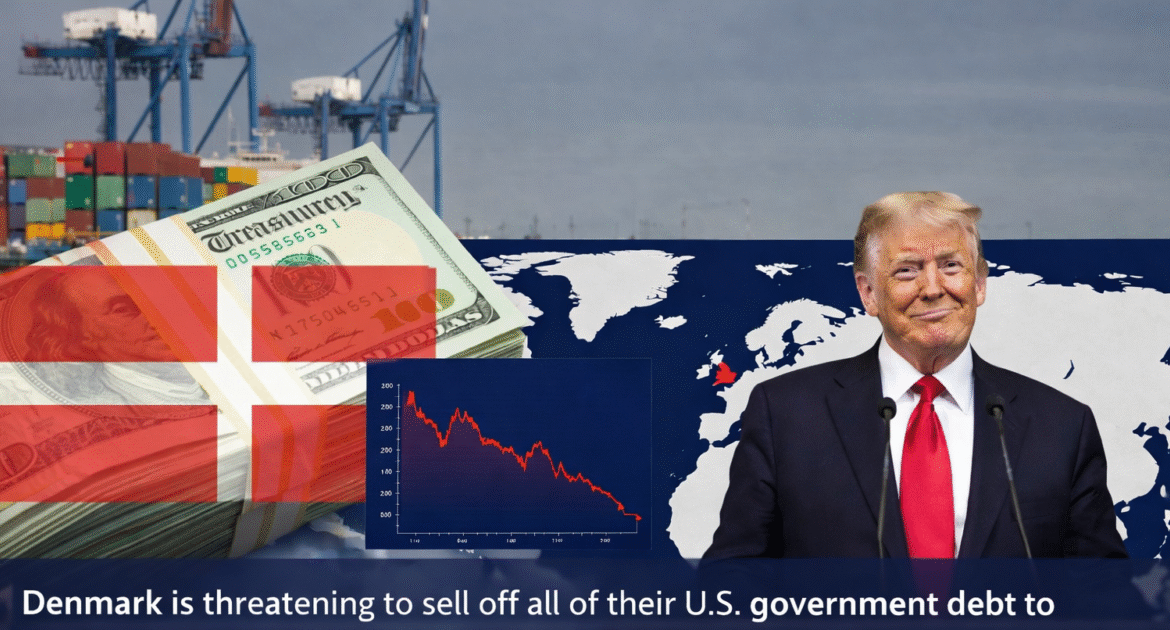
Denmark Threatens to Sell US Debt Over Greenland Dispute – Trump Unperturbed


A Danish pension fund, AkademikerPension, plans to sell its entire roughly $100 million holding of U.S. Treasuries by the end of January. The fund said the decision was driven by concerns over the U.S. credit rating, but also acknowledged that the dispute over Greenland made the move easier. Other European countries have threatened to sell not only U.S. government debt but also corporate stocks and bonds as retaliation for tariff pressure tied to Greenland.
Speaking at the World Economic Forum in Davos, President Trump said Europe could proceed if it wished, but insisted the United States “holds all the cards.” As is often the case, Trump is correct.
Many people do not understand what it means when they read that China or another foreign country “holds U.S. debt,” or that the United States is a debtor nation. It is more disturbing when world leaders appear not to understand how the debt market works.
Every country maintains a central bank that holds foreign currency reserves and gold. These reserves enable central banks to intervene in foreign exchange markets to manage their domestic currency’s value, facilitate international trade, and provide liquidity during crises. Central banks hold much of their reserves in U.S. Treasury securities, which they buy to weaken their domestic currency or sell to strengthen it.
As of the third quarter of 2025, the U.S. dollar accounted for 56.92% of global allocated foreign exchange reserves. This figure only includes U.S. Treasury securities, which are backed by the full faith and credit of the U.S. government. The U.S. has the highest tax revenue base in the world and one of the most efficient taxation systems. While all countries issue government debt, no other country offers the same level of backing as U.S. government securities.
The 56.92% figure significantly understates dollar dominance because it excludes other dollar-denominated assets. According to the June 2024 Treasury International Capital survey, total foreign holdings of U.S. securities reached $30.9 trillion, including Treasury debt at $8.2 trillion, U.S. agency debt at $1.3 trillion, corporate debt at $4.2 trillion, and equities at $16.9 trillion.
The dollar’s role is even more dominant in actual commerce. While 40-50% of global trade is directly invoiced in dollars, the U.S. dollar appeared on one side of 89.2% of all foreign exchange transactions according to the Bank for International Settlements’ 2025 Triennial Survey. When businesses in non-dollar economies trade with each other, they typically convert their currencies through the dollar as an intermediary. For example, when a Brazilian company pays a Japanese supplier in yen, the transaction converts Brazilian reais to dollars, then dollars to yen. The dollar facilitates the transaction even though it does not appear on the trade invoice. When accounting for this vehicle currency function, the dollar’s actual role in enabling global commerce approaches 90%.
The primary reason countries cannot just dump all of their US dollars out of anger is that there is no other currency or debt instrument that offers the stability, safety, and usability of the US dollar. The dollar offers unmatched liquidity in the world’s deepest bond market, is backed by the largest economy and a government that has never defaulted, and serves as the primary currency for international trade.
For years, there has been talk of the “nuclear option,” meaning that countries around the world would become so fed up with the United States that they would band together and sell their U.S. government debt on the same day. While it would be nearly impossible to organize something like that, it also would not hurt the United States.
Treasury bills, notes, and bonds have set maturity dates. They can be bought and sold hundreds of times, but the United States only has to pay at maturity. As a result, it is irrelevant to the U.S. who holds the debt at any given moment.
When the supply of an asset floods the market, its price falls. If all $8.2 trillion in U.S. Treasuries hit the market on the same day, prices would plummet. At that point, the U.S. Treasury would step into the open market and buy back its own debt at a discount. In that scenario, Donald Trump would go down in history as the man who reduced the U.S. national debt.
As part of open market operations, the U.S. Federal Reserve monitors bond markets and buys U.S. government bonds. When prices fall, the U.S. gets a bargain. The current threat of Denmark selling $100 million in Treasuries would not even register as a rounding error against the roughly $500 to $900 billion in average daily trading volume. U.S. Treasury Secretary Scott Bessent downplayed the significance of the Danish sell-off, calling the amount negligible and noting that Denmark has been reducing its Treasury holdings for years.
EU representatives have also floated the idea of divesting from all U.S.-based securities, including corporate stocks and bonds. This would be economic suicide for Europe. The very reason European investors put money into U.S. private companies in the first place was because they believed those firms offered the best investments with the highest upside potential. Selling strong U.S. companies in order to buy shares in firms they had previously rejected makes no economic sense.
Moreover, while the media claims that European investors hold over $10 trillion in U.S. equities, those assets are largely held by private firms, not governments. For Europe to carry out such a divestment, governments would have to pass sweeping and draconian laws forcing private companies and banks to sell U.S. stocks. Once again, prices would plummet, and institutional investors from the United States and Asia would move in and buy those assets at a discount. Europe would lose substantial value, while the U.S. and Asia would gain.
The idea of threatening the United States by trading in currencies other than the dollar, or by holding reserves and securities outside the dollar system, is not new. It has been discussed repeatedly since World War II but has never happened because there is no viable alternative. Even China has been unable to convince its BRICS partners to use the yuan instead of the dollar for more than a small percentage of their transactions or foreign currency reserves.
The post Denmark Threatens to Sell US Debt Over Greenland Dispute – Trump Unperturbed appeared first on The Gateway Pundit.