
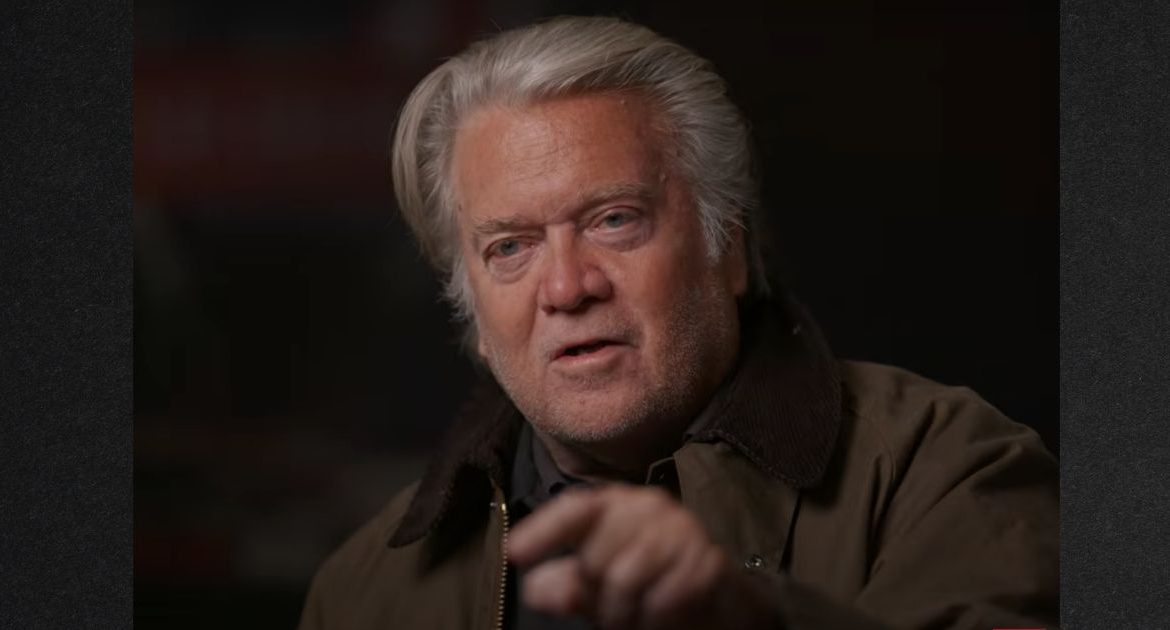
Report: Bannon Laying Groundwork to Shape the 2028 Post-Trump GOP Field

Steve Bannon, one of the most influential architects of the modern America First movement, appears to be steathily re-entering the political conversation surrounding the 2028 presidential race.
While publicly dismissing talk of a campaign as media fantasy, allies say Bannon is methodically positioning himself to shape—and potentially dominate—the post-Trump battlefield.
According to multiple reports, Bannon has begun the process of laying institutional groundwork that looks similar to an exploratory phase. Discussions about forming a political action committee, sounding out potential staff, and strengthening ties with grassroots organizers already underway behind the scenes.
Bannon’s recent appearances at Republican Party events in states like Colorado and Georgia have not gone unnoticed. These aren’t random speaking gigs, but strategic stops in states where party infrastructure and activist networks play a decisive role in shaping early momentum.
To establishment observers, this looks like ego or ambition. To Bannon’s allies, however, it’s something else—namely leverage. The goal, they say, is not simply winning office, but forcing the Republican Party to fully embrace economic nationalism, non-intervention abroad, and a hard confrontation with Big Tech oligarchs and multinational big business elites.
Former Congressman Matt Gaetz described a potential Bannon platform as combining the foreign policy restraint of Rand Paul with the economic populism of Elizabeth Warren—a direct assault on both neoliberal consensus and donor-driven conservatism.
Bannon has repeatedly rejected the idea that he’s running, at least for now. In his characteristically combative fashion, he has called the speculation “bullshit,” insisting his focus remains on supporting President Donald Trump and advancing the broader MAGA cause.
That support has included Bannon’s vocal support for a Trump third term, despite the Constitution’s two-term limit. Bannon has argued that the legal framework is more flexible than critics admit, famously saying that one could “drive a Mack Truck through the 22nd Amendment.”
To that end, Bannon is collaborating with prominent legal scholar Alan Dershowitz on a forthcoming book examining whether Trump could constitutionally serve again. The project undoubtedly signals that Bannon is thinking far beyond conventional political timelines.
Privately, some of Bannon’s allies suggest a contingency plan is already in place. If Trump ultimately declines or is legally barred from running again, Bannon could step forward as the standard-bearer of the movement he helped create in the years leading up to Trump’s initial victory in 2016.
What makes Bannon’s positioning especially notable is how unconventional it is. Associates envision a campaign centered not on traditional rallies or retail politics, but on his Capitol Hill–based “War Room” podcast—something that has become a nerve center for grassroots national-conservative populism.
Bannon has already demonstrated how this model works. Recent events organized under the War Room banner have drawn hundreds of activists and movement leaders, particularly around issues like border security, radical Islam, and cultural sovereignty and continuity.
His decision to temporarily relocate his show to Texas ahead of key primaries underscores the strategy. Bannon,instead of chasing mainstream press approval or donor dollars, Bannon appears to be doubling down on America First movement energy and issue-driven mobilization.
At the same time, Bannon has begun applying pressure to likely Republican contenders for 2028. Key figures like Vice President J.D. Vance, Secretary of State Marco Rubio, and Senator Ted Cruz have all faced pointed criticism from Bannon’s platform.
The common thread in those critiques is ideological discipline. Any candidate perceived as soft on Big Tech, interventionist foreign policy, or global entanglements is put on notice, very publicly.
This has unsettled parts of the GOP establishment, which hoped the populist-nationalist, anti-globalist wave might soften after Trump’s departure. Instead, Bannon appears determined to move it further in a nationalist direction.
Bannon views the stakes as civilizational, not at all personal. He has repeatedly framed the coming years as a struggle between national sovereignty and global managerial elites who, in his view, have hollowed out the American middle class and continue to do so.
Whether or not Bannon ultimately runs, his influence is already reshaping the field. Candidates will have to answer to the movement’s demands, not merely its donors.
The irony is that mainstream Washington pundits often still treat Bannon as some kind of fringe provocateur. In reality, he is operating as a power broker, shaping ideology, enforcing boundaries, and preparing for a future where Trumpism outlives Trump.
In that sense, it’s entirely possible that 2028 may not be about Steve Bannon the candidate at all. It very well could be about Steve Bannon ensuring that America First remains the only viable path forward for the Republican Party, and the country.
The post Report: Bannon Laying Groundwork to Shape the 2028 Post-Trump GOP Field appeared first on The Gateway Pundit.