
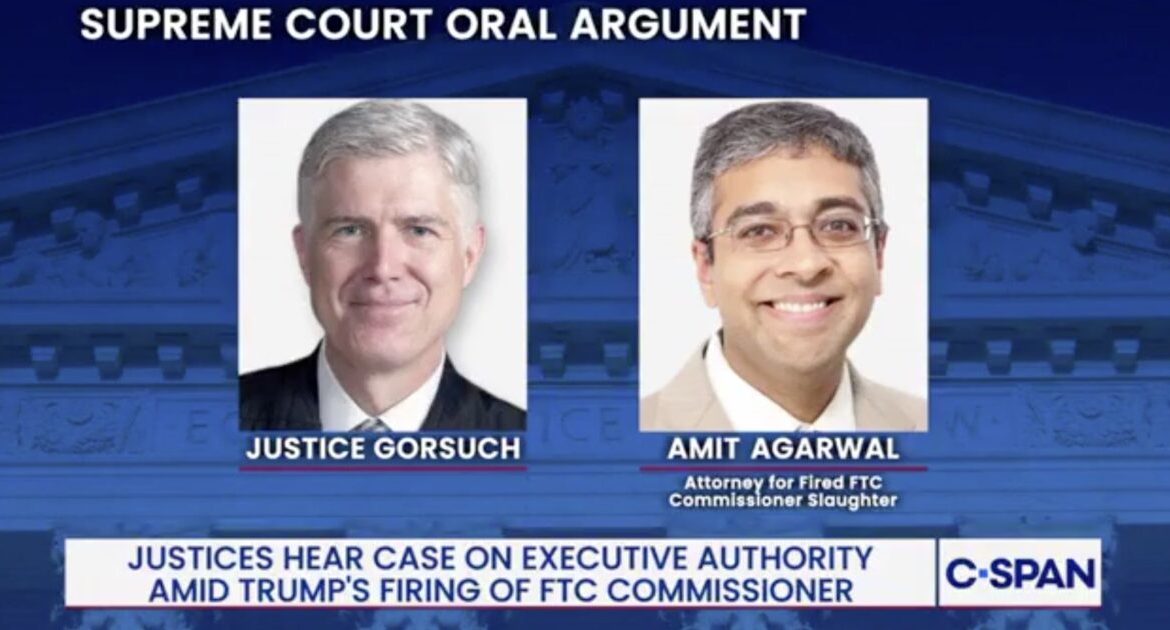
BRUTAL: Justice Gorsuch Easily DISMANTLES Fired Democrat FTC Commissioner’s Attorney on “Independent Agencies” Argument — ‘There Is NO Such Thing as Fourth Branch of Government’


Supreme Court Justice Neil Gorsuch tore apart the legal theory advanced by Amit Agarwal, attorney for fired Democrat FTC Commissioner Rebecca Kelly Slaughter.
The case, Trump v. Slaughter, centers on whether President Trump had constitutional authority to remove an unelected bureaucrat who openly defied his administration, and Gorsuch wasted no time exposing the intellectual contradictions underpinning the Left’s attempt to preserve a “fourth branch” of government.
Democrats have long relied on insulated “independent agencies” to carry out policy goals voters never approved and Congress never authorized.
Their strategy depends on stripping the elected president of the power to control the very officials who wield federal authority. But on Monday, the Supreme Court signaled it may finally put an end to this unconstitutional arrangement.
During the argument, Gorsuch turned to the heart of the matter: the Left’s attempt to prop up a “fourth branch” of government by dressing it up in modern jargon like “quasi-legislative” and “quasi-judicial.”
Gorsuch suggested that Agarwal’s entire theory, built on two words from Trump v. United States, wasn’t really a legal argument at all.
It was an attempt to “backfill” the infamous 1935 case Humphrey’s Executor, which insulated FTC commissioners from presidential removal.
Gorsuch flatly called out the incoherence of the modern “independent agency” framework:
“Maybe it’s a recognition that Humphrey’s Executor was poorly reasoned and that there is no such thing in our constitutional order as a fourth branch of government that’s quasi-judicial and quasi-legislative.”
For decades, Democrats have relied on these independent bureaucracies as political fortresses immune from presidential oversight. Gorsuch openly questioned whether their legal foundation was rotten from the start.
Justice Neil Gorsuch:
I just want to explore, just for a brief minute, I hope, your scintilla of conclusive and preclusive power theory. You agree, I assume, the President is vested with all the executive power.Amit Agarwal:
Yes.Justice Neil Gorsuch:
You agree that he has a duty to faithfully execute all the laws, civil and criminal.Amit Agarwal:
We agree that the Constitution imposes on the President a duty to faithfully execute the laws.Justice Neil Gorsuch:
All the laws?Amit Agarwal:
Well—Justice Neil Gorsuch:
Some laws he doesn’t have to? That would be news to our friends across the street.Amit Agarwal:
The Take Care Clause is a duty, and it is also a power. But the text of the clause does not provide that the President must have at-will presidential—Justice Neil Gorsuch:
I didn’t ask that.Justice Neil Gorsuch:
Does he have a duty to faithfully execute all the laws?Amit Agarwal:
We know from—Justice Neil Gorsuch:
Yes or no?Amit Agarwal:
I would say no, in the sense—Justice Neil Gorsuch:
No?Amit Agarwal:
In the sense that there are two different questions, and I want to make sure I’m answering the question.Justice Neil Gorsuch:
The question is: Does the President have a duty to faithfully execute all the laws? The answer is no. Why?Amit Agarwal:
He cannot break the law, for sure. Does he have to be vested with statutory authority to actually directly enforce or to exercise—Justice Neil Gorsuch:
I’m not asking whether he has to bring the indictment. I’m asking whether he has a duty to faithfully execute the laws.Amit Agarwal:
I think the President does not, under both history and tradition, have to have plenary power of supervision. But in the case of the FTC, he does have some power of supervision, including—if there is a demonstrable, palpable violation of law—the President could absolutely fire a Commissioner of the FTC under the plain language of the statute.Justice Neil Gorsuch:
So the answer is no, I guess. But you say that he does have to have direct supervision and removal authority for someone who has conclusive and exclusive authority to bring criminal prosecutions, right?Amit Agarwal:
That is our understanding of this Court’s decision in Trump v. United States.Justice Neil Gorsuch:
That’s your understanding?Amit Agarwal:
Yes.Justice Neil Gorsuch:
But not civil?Amit Agarwal:
That’s right.Justice Neil Gorsuch:
And just to be clear, that means if the government wants to bring a misdemeanor, that person has to be reportable to the President. But if the government wants to bring ruinous fines and penalties and injunctions, that person doesn’t?Amit Agarwal:
I don’t know the scope of this Court’s holding in Trump v. United States.Justice Neil Gorsuch:
I’m asking you for your theory, because it’s a very interesting theory. You’re building off of two words from Trump v. United States and putting a gloss on it that I’m not familiar with. I had understood the executive power, and he has conclusive and preclusive authority over that. But this line—I don’t know where it comes from. I’m wondering—I’ll be honest, I’ll put my cards on the table—maybe it’s a recognition that Humphrey’s Executor was poorly reasoned and that there is no such thing in our constitutional order as a fourth branch of government that’s quasi-judicial and quasi-legislative. Maybe you’re trying to backfill it with a better new theory that itself recognizes that we’ve got a problem.Amit Agarwal:
The theory that we are referring to, Justice Gorsuch, as we understand it, is not just based on this Court’s recent decision in Trump v. United States. It goes all the way back to Marbury v. Madison. Marbury does not use the term “conclusive and preclusive,” but it absolutely says—Justice Neil Gorsuch:
Neither does Humphrey’s. It uses “quasi” things.Amit Agarwal:
It talks about the distinction between authorities that are vested in the President and the President’s powers in the constitutional sense, and executive power in the constitutional sense. It actually cites Marbury v. Madison for that proposition.Justice Neil Gorsuch:
Sure, I would hope it would.Amit Agarwal:
Marbury itself distinguishes in the context of removability of federal offices.Justice Neil Gorsuch:
I guess I’m just wondering: If we take your theory to backfill Humphrey’s and go down this road, how are we supposed to decide which powers are exclusive for your purposes—as you understand it, not as I understand it from Trump v. United States—what powers are going to fall in and what are going to fall out? Are we going to have just as much litigation over that as anything else we might do in this case?Amit Agarwal:
I don’t think so. We’ve had this modern era of traditional independent agencies for a long time. We haven’t had any precedent ever striking them down, and this Court has not been, as far as I know, overwhelmed with difficult questions of line-drawing. In fact, from 1935 to 2025, we had pretty much unanimity among courts that traditional independent agencies are fine.Justice Neil Gorsuch:
We haven’t had a lot of litigation over Humphrey’s and its limits and its boundaries. You invoke it as a great decision.Amit Agarwal:
We’ve had a lot of litigation…Justice Neil Gorsuch:
We’re always going to have litigation over this separation of powers, aren’t we?Amit Agarwal:
There will always be litigation, absolutely. But the point is that this Court’s precedents—affirming Congress’s ability to work with presidents to create traditional independent agencies—has not generated any significant problem, still less an insurmountable one.
WATCH:
EPIC: SCOTUS Justice Neil Gorsuch goes OFF on the rogue bureaucratic state at today’s oral argument, as the Court seems poised to hand Donald Trump a victory
“…there is no such THING in our constitutional order as a 4th branch of GOVERNMENT!”
“Maybe it’s a recognition… pic.twitter.com/27pdPhwrtt
— Tony Seruga (@TonySeruga) December 9, 2025
The post BRUTAL: Justice Gorsuch Easily DISMANTLES Fired Democrat FTC Commissioner’s Attorney on “Independent Agencies” Argument — ‘There Is NO Such Thing as Fourth Branch of Government’ appeared first on The Gateway Pundit.